

George Farmer
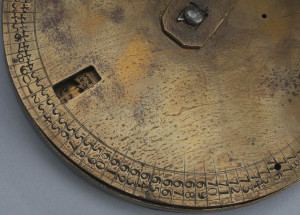
On 8 October 1867, George Farmer of Flint, Michigan, patented a tallying instrument (US patent No. 69647). The patent model of the device (up to 1880, the US Patent Office required inventors to submit a model with their patent application) is still preserved in the National Museum of American History,..Read More
Alonzo Johnson
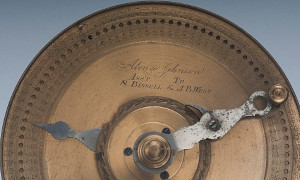
Alonzo Johnson, a machinist from Springfield, Mass., is a holder of two US patents for calculating devices: patent Nr. 73732 from 28 Jan. 1868 and patent Nr. 85229 from 22 Dec. 1868). The first patent was granted to Alonzo Johnson and James Loomis as co-inventor (James A. Loomis (29 Dec..Read More
Charles Webb
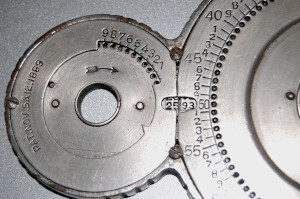
The American poet, author, and journalist Charles Henry Webb (1834–1905) from New York was a holder of several patents for calculating devices. First was the USA patent №75322 from 10 March 1868, for an adding-machine. Later (in November 1889) he took out two other patents for an improved version of..Read More
Charles Corliss
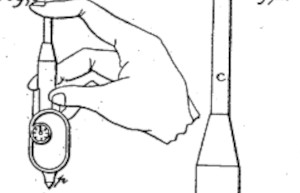
On 23 June 1868, Charles Corliss (1827-1897), a farmer and landowner from Haverhill, Massachusetts, received two patents for instruments for adding and registering numbers (US patents Nr. 79209 and Nr. 79272). One of the patents is granted to Corliss and Nelson Spofford (1826-1906), a surveyor and inventor from Haverhill, who..Read More
William Jevons
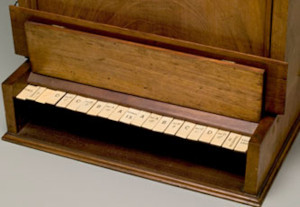
William Stanley Jevons (1835–1882) was an English economist and logician, a major figure, both in Britain and internationally, in the fields of political economy and social reform. Jevons is most often credited with being the first theorist to make economics a mathematical discipline, and he is regarded as one of..Read More
Elizur Wright
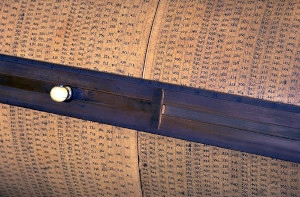
In the 1860s, Elizur Wright, an American mathematician, journalist, and abolitionist (living at the time in Medford, Massachusetts), sometimes described as the father of life insurance in the United States, invented a calculator, called Arithmeter (it was a large cylindrical slide rule, an equivalent of a linear slide rule some..Read More
Gilbert Chapin
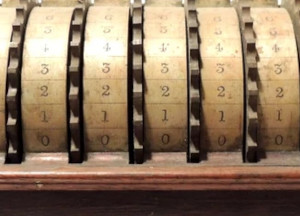
The American businessman Gilbert Warren Chapin was a holder of three quite interesting patents for calculating machines—US patent №99533 and US patent №106999 from 1870, and US patent №646599 from 1900. The first and third patents are for key-operated adding devices, while the second is for a small adder with..Read More
John Groesbeck
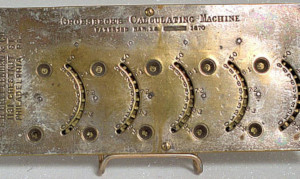
At the end of the 1860s, John Groesbeck (1833-1884), a consulting accountant from Philadelphia, Pennsylvania, and many years a teacher and principal of Crittenden’s Philadelphia Commercial College devised a simple adding machine, for which he took out a US patent №100288 on 1 March 1870. Although in small quantities, the..Read More