

Joseph Alexander
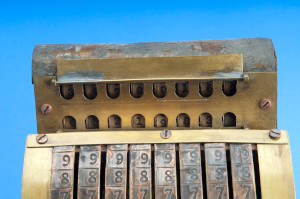
At the beginning of the 1860s Dr. Joseph Bell Alexander (1821-1871) of Baltimore, Maryland, devised a rather interesting calculating machine, and on 15 March 1864, took out US Patent №41898 for it. It seems the machine never went into production and only the Patent Office model survived to the present..Read More
Helge Palmcrantz
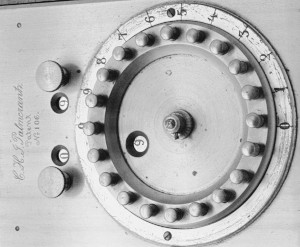
In the middle 1860s the young Swedish engineer Carl Helge Julius Palmcrantz (1842-1880), who just finished his studies at the Teknologiska Institutet (Technological Institute of Stockholm) and returned unemployed (there was a recession with a large shortage of work in Sweden) to his parental home in Jämtland, was trying to..Read More
Friedrich Arzberger
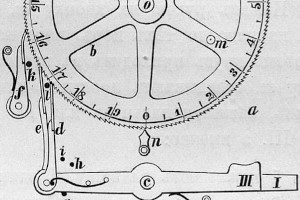
In the middle of the 1860s, the young Austrian mining engineer and professor Friedrich (Fritz) Arzberger constructed one of the early column adding machines with keys (after the pioneering machines of James White, Luigi Torchi, and Jean-Baptiste Schwilgué), although it possess only two keys—for numbers 1 and 3. The device..Read More
Viktor Bunyakovsky

Viktor Yakovych Bunyakovsky (Віктор Якович Буняковский) (1804-1888) is a famous Russian mathematician, member, and later vice-president of the Petersburg Academy of Sciences. He made significant contributions in the areas of number theory and probability theory and is credited with an early discovery of the Cauchy-Schwarz inequality. Besides being an eminent..Read More
Alexander Davies
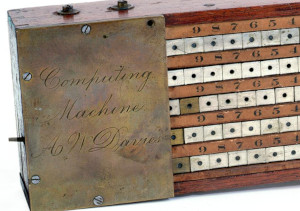
On 18 June 1867, Alexander Davies (1832-1900) from Cleveland, Ohio, received the US patent Nr. 65883 for computing machine—it was a slide bar adder, quite similar to the earlier adding device of George Fowler, patented in 1863. The patent model of the device (see the nearby photo) survived to our..Read More
Amos Mendenhall
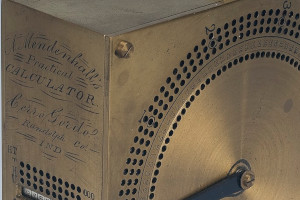
On 13 August 1867, Amos Mendenhall, a merchant and amateur mechanic from Cerro Gordo, Randolph County, Indiana, patented an improved calculating machine (US patent Nr. 67786). The patent model of the device (up to 1880, the US Patent Office required inventors to submit a model with their patent application) is..Read More