

Semyon Korsakov
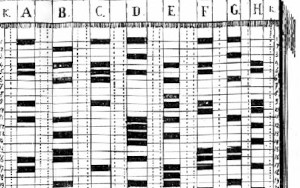
In 1817 Semyon Nikolaevich Korsakov, an officer in Russian Justice Ministry and a veteran of the Napoleonic Wars, accepted a position in the statistics department of the Police Ministry in St. Peterburg. Inspired by his daily work, soon Korsakov was intrigued with the possibility of using machinery to enhance natural..Read More
Luigi Torchi
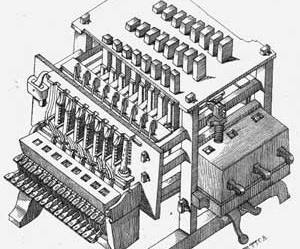
The machine of the Italian Luigi Torchi from Milan was the first full-keyboard/direct multiplication machine in the world, moreover, it was the first practical keyboard calculator, as the earlier key-driven adding machine, described by the English engineer James White, seems to remain only on paper. Some 40 years will be..Read More
Analytical Engine of Charles Babbage
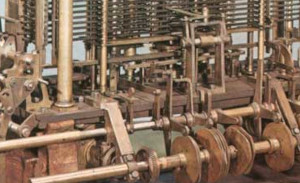
It seems a real miracle, that the first digital computer in the world, which embodied in its mechanical and logical details just about every major principle of the modern digital computer, was designed as early as in 1830s. This was done by the great Charles Babbage, and the name of..Read More
Joseph Henry
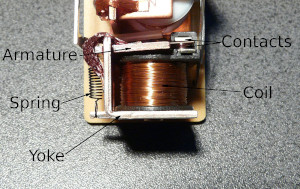
The electromechanical relay, used as a constructive part of some early calculators and computers, was invented in 1835 by the brilliant American scientist Joseph Henry (1797–1878), known mainly as the inventor of the electromagnetic phenomenon of self-inductance and mutual inductance. Henry’s invention was based on the work of the British..Read More
Pehr-Georg Scheutz
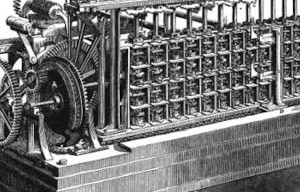
The Swede Pehr Georg Scheutz (1785–1873) was a remarkable man—a lawyer, translator, and inventor. When he read a description of the differential engine of Babbage in 1834, he decided to build such a machine. And, despite the fact, that he was neither a mathematician (like Babbage), nor an engineer, he..Read More
Thomas Fowler
In 1840, Thomas Fowler, an English businessman, self-taught mathematician, and inventor, created a unique ternary calculating machine in his workshop in Great Torrington, a small market town in the north of Devon, England. In 1842 Fowler devised a greatly improved model, which was exhibited in the museum of King’s College..Read More
David Roth

David Roth (1808-1885) was an Austrian Jew and Parisian doctor, who around 1840 turned his attention to the design and construction of mechanical calculators. Between 1840 and 1844, Roth registered six patents (totaling 72 pages), as the first patent was registered in May 1840, the last in March 1844. Besides,..Read More
Chaim Zelig Slonimski
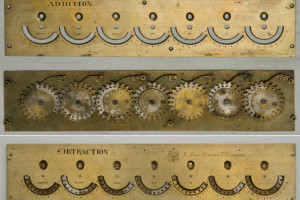
The Polish Jew Chaim Zelig Slonimski (1810-1904), a Hebrew publisher, astronomer, inventor, and science author, commenced his activities with calculating machines around 1838, when he, visiting Byelostok, heard that a Jew had spent there several days, collecting subscriptions for tables of calculations, which he had invented. The tables had no..Read More