

Jay Forrester (Whirlwind and SAGE)
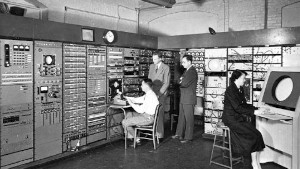
After high school, in 1936 Jay Forrester (1918-2016) enrolled in the Engineering College at the University of Nebraska to study Electrical engineering, and then in 1939 went to do graduate work at MIT on servomechanisms. He stayed at MIT until 1944 when he chose a Navy-sponsored program to design computers..Read More
John Bennett
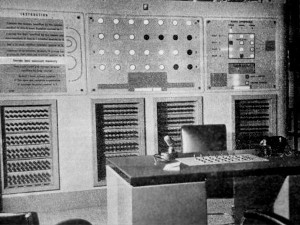
In 1950 the British company Ferranti Ltd., which produced the world’s first general-purpose commercial computer, the Ferranti Mark 1, had undertaken to display a computer at the 1951 Festival of Britain (a national exhibition and fair that reached millions of visitors throughout the United Kingdom in the summer of 1951). By..Read More
Geoffrey Hill
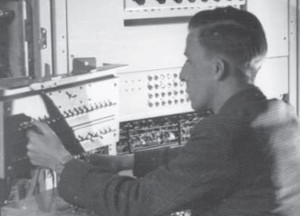
The first demonstration of computer music was made (and it caused quite a stir) during the inaugural Conference of Automatic Computing Machines in Sydney, Australia, held from 7 to 9 August 1951. The program was written by Geoff Hill, a young computer programmer with perfect pitch, and ran on the..Read More
Geoffrey Dummer (integrated circuit)
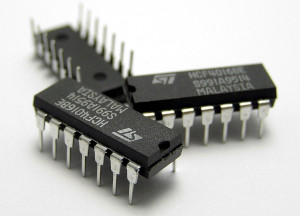
The first man, who must be credited for the conceptualization of the integrated circuit, is the British engineer Geoffrey Dummer. Geoffrey William Arnold Dummer (1909–2002) was an electronics author and consultant, who passed the first radar trainers and became a pioneer of reliability engineering at the Telecommunications Research Establishment in..Read More
Alexander Douglas
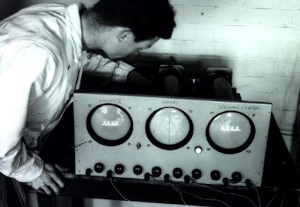
In 1952 Alexander Shafto Douglas (1921–2010), known as “Sandy”, a graduate student at Cambridge, was writing his Ph.D. thesis on human-computer interaction for the University of Cambridge. He decided as part of his thesis to create a computer game on the EDSAC computer at University (one of the first stored-program..Read More