

Frederic Williams and Tom Kilburn
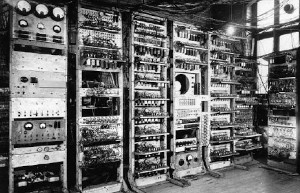
The world’s first stored-program electronic digital computer, the English Small Scale Experimental Machine (SSEM, nicknamed the Baby) successfully executed its first program on 21 June 1948. That program was written by Tom Kilburn, who actually built the machine, designed by his mentor—Frederic (Freddie) Williams. rederic Calland Williams (1911-1977) gained a BSc (1932) and..Read More
William Walter
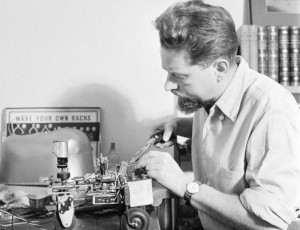
The first robots that were programmed to “think” the way biological brains do and meant to have free will were built in the late 1940s by William Grey Walter (1910–1977)—an American-born British neurophysiologist, and cybernetician, who wanted to prove that rich connections between a small number of brain cells could..Read More
Jacob Rabinow (hard disk)
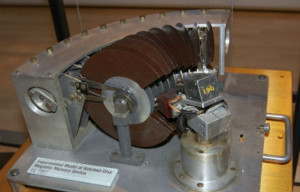
At the end of the 1940s, the American engineer and prolific inventor at the National Bureau of Standards (NBS), Jacob Rabinow (1910-1999), served as a consultant on computer development services for government agencies. Asked to design a machine to record on and read from sheets of magnetic material, he instead..Read More
Edmund Berkeley
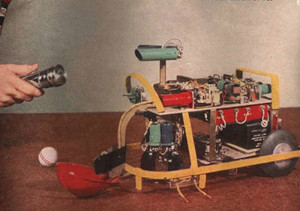
Edmund Callis Berkeley (1909–1988) was an American computer scientist, publisher, and social activist, who worked to achieve conditions that might minimize the threat of nuclear war. The first meeting of Berkeley with computers was in 1939 when he visited Bell Laboratories to see George Stibitz’s Complex Number Computer. Next was..Read More
Angela Robles
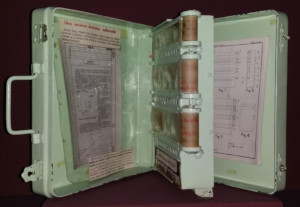
In the late 1940s Angela Ruiz Robles, a Spanish teacher, writer, and inventor, designed an analog device called the Enciclopedia Mecánica, which can be considered a forerunner of the modern electronic book. t that time, being the director of Instituto Ibáñez Martín in Ferrol, Galicia, Spain, Robles came up with the idea..Read More
Arthur Samuel
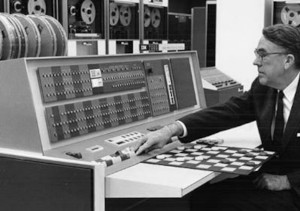
After his work for Bell Laboratories since 1928, mostly on vacuum tubes, including improvements of Radar during World War II, the distinguished electrical engineer Arthur Lee Samuel (1901-1990), became a professor of electrical engineering at the University of Illinois at Urbana–Champaign, where he initiated the ILLIAC project. ILLIAC (Illinois Automatic..Read More
Ben Laposky
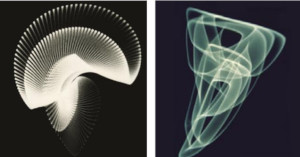
Ben Laposky (1914–2000) was an American mathematician, artist, and draftsman from Cherokee, Iowa, who has been credited as the pioneer of electronic art, making the first computer graphics. fter his service at the US Army until the middle of 1944, Laposky returned wounded to his original work in Cherokee, but..Read More