Edward Condon
In April 1940, in the Westinghouse Pavilion at the World’s Fair in New York (together with Westinghouse’s robots Elektro and Sparko) was shown an electromechanical computer, playing the Nim game. The originator of the idea was the American physicist Edward Uhler Condon (1902-1974), who in 1937 was employed at Westinghouse..Read More
Isaac Asimov
In the March 1942 issue of Astounding Science Fiction magazine the American writer Isaac Asimov introduced The Three Laws of Robotics in his short story “Runaround” (see the story). The Three Laws are: 1. A robot may not injure a human being or, through inaction, allow a human being to..Read More
Paul Eisler (printed circuit board)
After the remarkable genius and self-taught Viennese engineer and inventor Gustav Tauschek, another Viennese engineer and inventor, named Paul Eisler, made a significant contribution to the modern electronics industry and computers with the invention of the printed circuit board (PCB) while working in London in the second half of the..Read More
Max Newman and Tommy Flowers
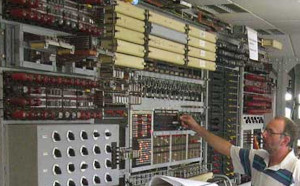
WWII hindered the progress of computer inventors like Atanasoff and Zuse, but had the opposite effect on the first British steps toward the creation of an electronic computer. During the war, the Department of Communications of the British Foreign Office created machines, which used electronic circuits to assist the British..Read More
John von Neumann
The famous mathematician John Louis von Neumann (1903-1957) was born in a prosperous Jewish family in Budapest, Austro-Hungarian Empire, as János Lajos Neumann. A child-prodigy, János received his Ph.D. in mathematics from Pázmány Péter University in Budapest at the age of 22, simultaneously earning a diploma in chemical engineering from..Read More
John Mauchly and John Eckert
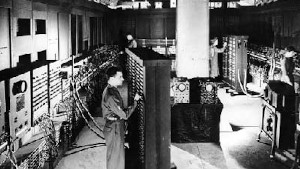
For more than 25 years ENIAC was considered the first digital electronic computer in the world. As late as the beginning of the 1970s this assertion was proved false. First, by the famous trial Sperry Rand Corporation vs. CDC and Honeywell, which started in 1971, and later by the information,..Read More
Murray Leinster
Murray Leinster (1896-1975) was a nom de plume of William Fitzgerald Jenkins, a famous American writer of science fiction and alternate history. He wrote and published over 1500 short stories and articles, 14 movie scripts, and hundreds of radio scripts and television plays. n the March 1946 issue of the American science..Read More
Goldsmith and Mann
U.S. Patent 2455992 (see the patent US2455992), filed by two American physicists—Thomas Toliver Goldsmith Jr. (1910–2009), director of research for DuMont Laboratories in New Jersey, and his colleague Estle Ray Mann (1904-1965), on 25 January 1947, describes the world’s first cathode ray tube based game, so-called “Cathode-ray tube amusement device”...Read More
Andrew and Kathleen Booth
In 1946, Kathleen Hylda Valerie Britten, a young 24 y. o. BSc in mathematics (1944) from the University of London, joined a team of mathematicians at London’s Birkbeck College who were performing calculations for scientists using X-ray images to determine crystal structures. There she met Andrew Donald Booth (1918-2009), a..Read More
Curt Herzstark
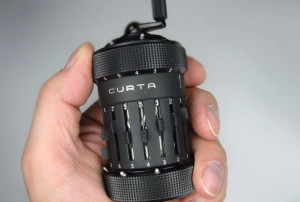
The Curta is a remarkable mechanical calculator, based on the stepped drum mechanism of Gottfried Lebnitz. It is a small, hand-cranked mechanical calculator, conceived by Curt Herzstark at the end of the 1920s, designed in the early 1930s, but introduced as late as 1948. It has an extremely compact design,..Read More