Fawcett Plumb
On 17 June 1881, Fawcett Plumb (1834-1919), a businessman, politician, and prolific inventor from Streator, Illinois, applied for a patent for keyboard adding machine. The US patent Nr. 256591 was granted on 18 April 1882. After the three first key-operated calculating machines in the world, invented in Europe (machines of..Read More
Cushman Crary and Mary Winter
On 23 May 1882, Mary E. Winter of Galesburg, IL, and Cushman W. Crary of Chicago, IL (assignor to Mary Winter), patented a keyboard adding machine (see US patent No. 258518). Interestingly, one of the early keyboard calculating machines in the US and the world was also invented by an..Read More
Azevedo Coutinho
In the early 1880s, the young Portugal journalist António Júlio Rodrigues de Azevedo Coutinho (1860-1918) devised an interesting keyboard adding device, which he patented in Brazil in 1882, and later in Great Britain (patent Nr. 188410781, 30 July 1884), and Germany (patent №30421, 19 August 1884). The adding machine of..Read More
Albert Stettner
Albert Stettner Jr., a mechanic from Berlin, Prussia, was a holder of two German (DE21236 and DE23098 from 1882) and one USA (US277627 from 1883) patent for keyboard adding machines. The patents DE23098 and US277627 are describing the same device. Let’s examine the machine of Stettner, using the patent drawing..Read More
William Beatley
The American William Henry Beatley (1847-1934), a millwright of Humansville, a small town in Polk County, Missouri, was a holder of two patents for calculating devices (adding machines) from 1883 and 1884. Interestingly, the witness of first patent of Beatley was John Briggs Barnett (1843-1922), a founder and president of the..Read More
Joseph Edmondson
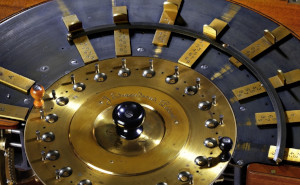
In the early 1880s the inventor Joseph Edmondson from Halifax, Yorks, England, devised an interesting circular calculating machine, based on the stepped-drum mechanism of Leibniz, which he patented in 1883 in Great Britain (patent No. 188316, from 1 January 1883) and in France (patent No. 158544, 14 Nov 1883). The..Read More
Charles Pidgin
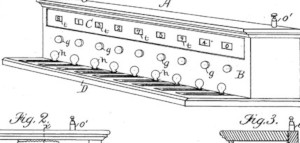
The prominent US statistician, romance novelist, and amateur engineer Charles Felton Pidgin (1844-1923) from Boston, Mass., was a holder of quite a few patents (at least ten) for various devices, like indicator, apparatus for compiling statistics (Pidgin’s system for the census, the so-called “chip” system, in the late 1880s was..Read More
Otto Büttner
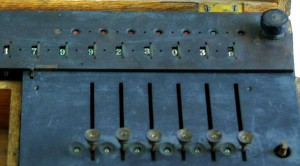
On 25 Sep 1883 Carl (Karl) Otto Büttner (1859-), a young mechanical engineer from Dresden, Germany, patented (together with his partner Carl Gustav Heyde) his first calculating machine (German patent №DE26640). Carl Gustav Th. Heyde (born on 25 Sep 1846 in Dresden, died 13 Nov 1930 in Dresden), was an..Read More
Herman Hollerith
In 1879 the bright and unmanageable teenager Herman Hollerith (1860-1929) graduated with distinction from the School of Mines at Columbia University in New York and went to work as a special agent for the US Census Office in Washington, D.C. One of his professors of engineering, William P. Trowbridge (1828-1892),..Read More
David Rush
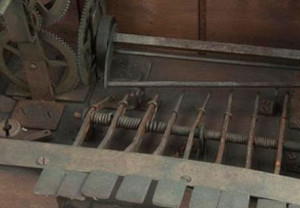
David Marion Rush of Louisburg, Missouri, applied for a patent for ten-key non-printing manually operated adding machine on 25 July 1883, and the patent (U.S. Patent Nr. 292256) was granted on 22 January 1884. A part of the patent model survived to our time and it is kept now in..Read More


