

Caroline Saruba
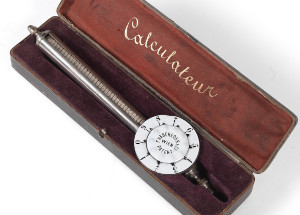
On 22 October 1880, one Caroline Sarúba from Vienna received an Austrian patent Nr. AT4264 (see the patent drawing below) for Calculateur Kolonnen-Addierstift (adding pencil). The machine was put into production by company F. Habereder & Co. of Ferdinand Habereder in Vienna, Griesgasse 26. The adding device of Saruba/Habereder is..Read More
Hugues Beaucourt
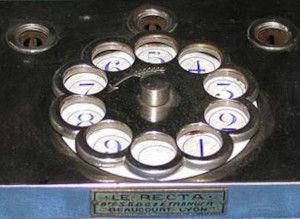
On 18 February 1881, Hugues Beaucourt (1845-1919), a son of the famous organ-builder from Lyon, France—Hippolyte-César Beaucourt (1822-1888), patented (French patent No. 141208) appareil pour calculer, an interesting adding device with rotatable (similar to telephone number dial) input mechanism. Later in the same 1881, he got a Spanish patent (Pat...Read More
Samuel Tate
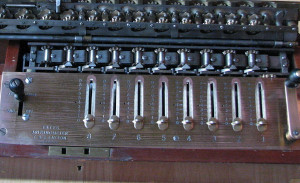
The first English stepped drum machine (it was a Thomas de Colmar-type arithmometer) was devised around 1880 by Samuel Tate (1840-1917), an iron worker and mechanical engineer from Sedgley, Staffordshire. In 1879 the Prudential Assurance Company challenged English makers to produce a more reliable machine than that of Thomas, announcing..Read More
Michael Bouchet
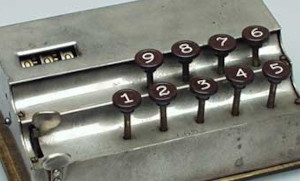
Michael Bouchet (1827-1903) from Louisville, Kentucky, USA, was a holder of two USA patents for single-column adding devices (known also as single digit adders)—Patent №251823 from 1882, and Patent №314561 from 1885. According to his biographer, Bouchet was responsible for the financial affairs of his diocese in the 1860s and..Read More
Charles Peirce and Allan Marquand
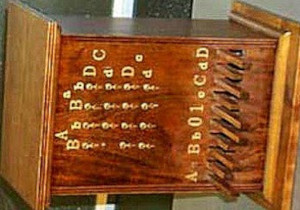
Charles Sanders Peirce (1839–1914) was a famous American philosopher, logician, mathematician, and scientist. He was an innovator in many fields, including philosophy of science, epistemology, metaphysics, mathematics, statistics, research methodology, and the design of experiments in astronomy, geophysics, and psychology, although he considered himself a logician first and foremost (he..Read More
Christian Hergenroeder
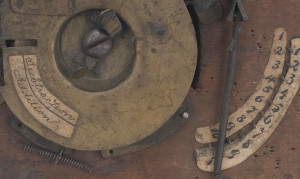
On 10 October 1882, a patent for a simple adding device (US patent Nr. 263904) was granted to Christian W. Hergenroeder of Baltimore (see the nearby image). The patent model of the device survived to our time and is kept now in the collection of the National Museum of American..Read More