

Johan Hellström
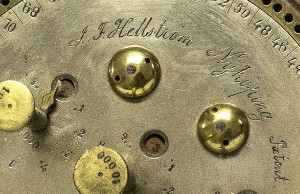
In the middle 1870s, the Swedish machinist Johan Fredrik Hellström devised räknemaskin (calculating machine), an interesting rounded adding device, similar to the earlier calculators of Braun, Leupold, and Hahn. The invention was announced in the Swedish press (e.g. in the newspaper Wermlands Läns Tidning on 21 June 1878). The calculating machine..Read More
Oberlin Smith and Valdemar Poulsen
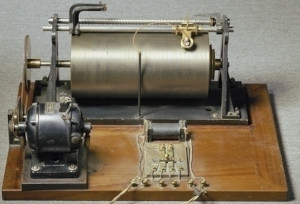
Magnetic tape is the oldest memory media for computers, still in use today. A tape was used for the first time to record data in 1951 in the Mauchly-Eckert UNIVAC I computer and is still in use today as a cheap and reusable archive media. So, who invented magnetic recording,..Read More
Ramón Verea
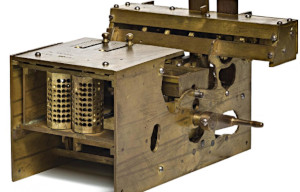
In 1878 Ramón Silvestre Verea Aguiar y García (1833-1899), a Spaniard, and newspaper publisher in New York, patented a direct-multiplying calculating machine, which seems to be the second patented machine of this type in the world (after the machine of Edmund Barbour), ten years before the first popular direct-multiplying machine..Read More
Reuben Rodney James
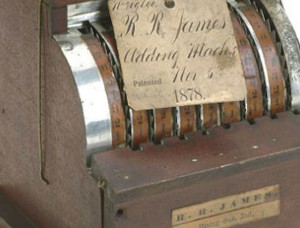
On 5 November 1878, Reuben Rodney James (1826-1904), a farmer from Rising Sun, Indiana, took out a US Patent №209690 (see the patent of R. R. James) for a simple adding machine, similar to the earlier calculators of his compatriots Jabez Burns, John Ballou, Joseph Harris, and Milton Jeffers. It..Read More
Arthur Burkhardt
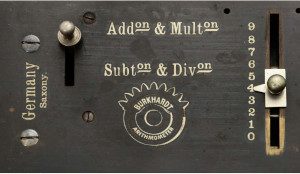
The foundation of the calculating machine industry in Germany, one of the leading industries of its kind for several decades afterward, was laid in the second half of the 1870s by two young German engineers—Kurt Dietzschold (1852-1922) and Arthur Burkhardt (1857–1918), in Glashütte (a small town in Sächsische Schweiz-Osterzgebirge, which..Read More
James Ritty
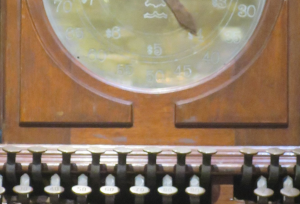
In 1878 one James Ritty, a 42 years old saloon keeper from Dayton, Ohio, was brooded so much over the peculations in his business, that he suffered a breakdown and decided to take a steamboat vacation trip to Europe. His business seemingly flourished, but he lost money, and he knew..Read More
William Briggs
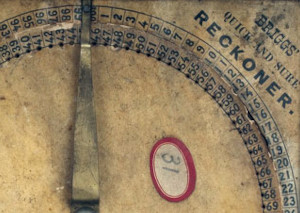
On 2 December 1879 William Briggs (1813-1887), a farmer and miller of Stoughton, Massachusetts, received a patent for an arithmetical calculator (see US patent No. 222126). The patent model of the device (up to 1880, the US Patent Office required inventors to submit a model with their patent application) is..Read More
Juri Diakov
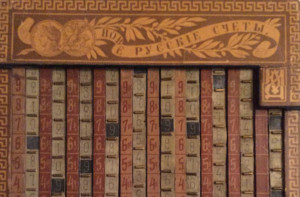
Around 1874, the Russian military engineer from Sankt Peterburg, captain Juri I. Diakov (Юрiй И. Дьяковъ), devised a simple row adder, one of many adding devices based on Abaque Rhabdologique of Claude Perrault. However, unlike the abacus of Perrault, the device of Diakov used endless bands, moved during the calculations..Read More