

Louis Chambon
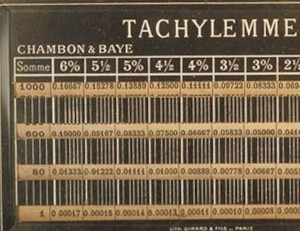
The Parisian Casimir Louis Chambon was a holder of two French patents for table-based calculating devices—French patent Nr. 115319 from 3 Nov 1876 for Calculateur mécanique universel, and French patent Nr. 198553 from 28 May 1889 for Multiplicateur Diviseur, granted to his company—Société Chambon et Baye, représenté par Dumas. The..Read More
Marshall Cram
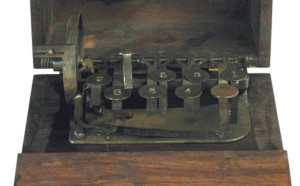
At the beginning of 1877 the young 23-year-old self-taught mechanic Marshall Cram, working as the first foreman of the Mankato Manufacturing Company machine shop in Mankato, Minnesota, stumbled upon a problem. One of his duties was to keep books at night, which needed calculations, so wanting to make his work..Read More
William Hart
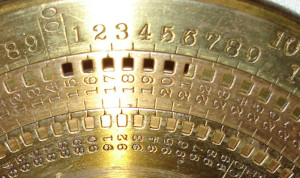
The William Hart’s story had many twists and turns. He was a watchmaker, jeweler, businessman, and prolific inventor. Hart had quite a few patents for various instruments and devices, but it seems these devices were never used. That’s not the case however with his calculator, known as Hart’s Mercantile Computing..Read More
Louis Troncet
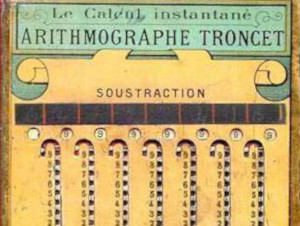
After the slide adders of Claude Perrault, César Caze, and Heinrich Kummer, in 1889 the French teacher, school director, inventor, scientist, and writer Louis-Joseph Troncet (1850-1920), created his version of this type of calculator, which he called Arithmographe. Troncet’s invention became so popular that the term “Troncet-type” is often used..Read More
Milton Hinkle
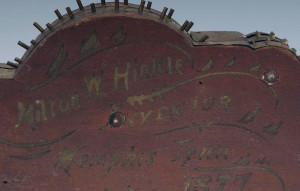
In 1877 Milton W. Hinkle of Memphis, Tennessee, invented a simple adding device, which he patented on 5 March 1878 (US patent No. 200911). The machine was somewhat similar to the earlier devices of his compatriots Jabez Burns, John Ballou, Joseph Harris, and Milton Jeffers. Only the patent model of..Read More
Peter Johann Backman
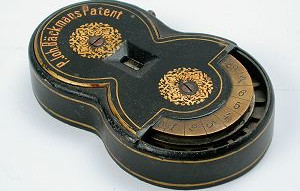
Around 1877 the Swedish public school teacher Per (Peter) Johann Bäckman from Stockholm invented an adding device, similar to the earlier calculator of Charles Henry Webb, and applied for patents in Sweden and Germany. The Swedish patent №205 of å framstäld räknemaskin för addition for nine years was granted on..Read More
William and Hubert Hopkins
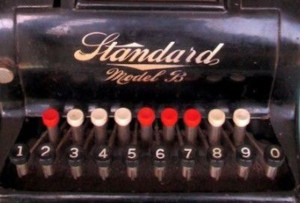
The Hopkins brothers, William and Hubert, from Saint Louis, are the holders of more than 30 patents for adding machines and calculating mechanisms, mainly for 10-key calculators. Naturally, Hopkins’ remarkable contribution to the field of mechanical calculators had been started as early as the 1870s with the older brother, William..Read More