

Martin Wiberg
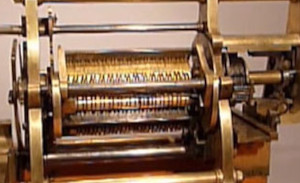
In the mid-1850s, the Swede Martin Olsson Wiberg (1826-1905), a Doctor of Philosophy from Lund University and an amateur mechanic, became very interested in the printing business and had the intention of developing a composing machine. In 1854, Wiberg was in London to show off a setting machine, i.e., a..Read More
Herschell Filipowski
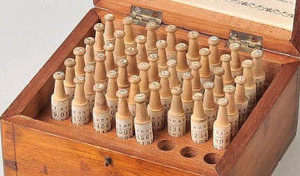
About 1860 the English mathematician, linguist, and editor Herschell Filipowski designed and published a description of his Calculating Machine for Multiplication and Division, similar to Napier’s Bones, but actually based on Slonimsky’s theorem. It seems only two contrivances survived to our time (see the photos below), one at the Science..Read More
Thomas Strode
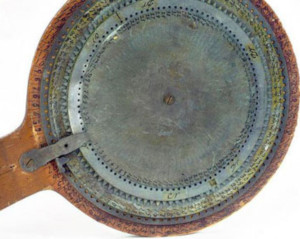
Thomas Strode (1810–1880), a storekeeper and farmer from Coatesville, Chester county, Pennsylvania, was a holder of three patents for calculating devices: US patent №30264 from 1860 for an adding machine (calculator), similar to Calculating Clock of Schickard and Pascaline of Blaise Pascal, and two patents for circular stylus-operated adding machines..Read More
Samuel Butler
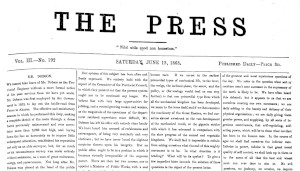
In the 13 June 1863 issue of The Press newspaper in Christchurch, New Zealand, was published a correspondence with the fancy name Darwin among the Machines (you can see the full text of the correspondence at the bottom of the page, or to click for the PDF version). The author was signed Cellarius, which was a..Read More
George Fowler
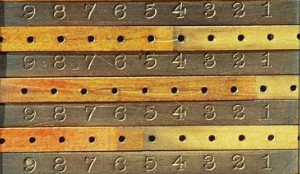
Yet another Fowler, this time the American George B. Fowler (1834-1891), wrote his name in the history of computing devices, after the Englishman Thomas Fowler, the creator of a unique ternary calculating machine in 1840. George Fowler’s machine from 1863 was a simple stylus-operated adding device without a carrying mechanism,..Read More
Milton Jeffers
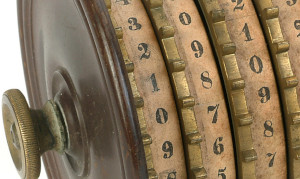
On 29 September 1863, one Milton C. Jeffers of New York was granted a patent (US patent No. 40105) for a simple adding device, quite similar to the earlier calculating devices of his compatriots Jabez Burns and John Ballou. In Jeffers’ patent is mentioned, that his device is an improvement..Read More
Emile Grandjean
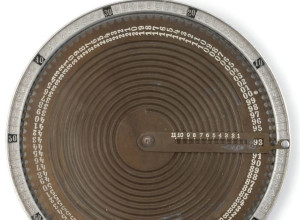
On 2 February 1864, Emile Grandjean, a French watchmaker (horlogère) from Fumay (Ardennes), received a 15-year patent (see French patent N°61637) for an adding machine, called Additionneur Grandjean. The Scottish pastor Brown’s Rotula Arithmetica from the 1690s can be seen as the archetype of all of these concentric toothed-disk-adding devices...Read More