

Tito Gonnella
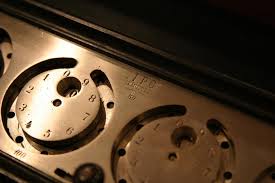
The Italian physicist, mathematician, and inventor Tito Gonnella (1794–1867), professor of mathematics and mechanics at the Florentine Accademia di Belle Arti di Firenze, is primarily known as the inventor (in 1824) of one of the first planimeters (an instrument for measuring the area, enclosed by an irregular closed curve) in..Read More
Thomas Hill
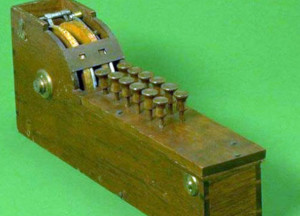
The improved arithmometer of the Reverend Thomas Hill (1818-1891), a Unitarian clergyman in Waltham, Massachusetts (later he became a famous scientist, educator, President of Harvard University, and one of the most profound yet brilliant mathematicians in the USA), was the first key-driven calculating machine, made in the United States, which..Read More
Niccola Guinigi
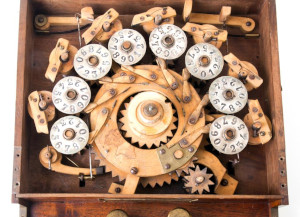
In the 1850s (or even earlier) Count Niccola Guinigi-Magrini, a nobleman from Lucca, Italy, designed and made a simple dial adder (which he called Manipolatore Aritmetico—Arithmetical Manipulator) with a unique design that summed eight-digit figures up to 99,999,999. Now the only surviving device is exposed in the Arithmeum Museum, Bonn,..Read More
Jabez Burns
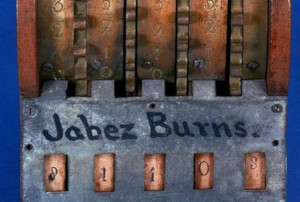
At the end of the 1850s Jabez Burns (1826-1888), a bookkeeper and peddler from New York desperately needed a tool to facilitate the lengthy calculations, performed on daily basis. That’s why he invented a simple adding device, for which on 24 August 1858, he took out the US patent №21243 for..Read More
John Ballou
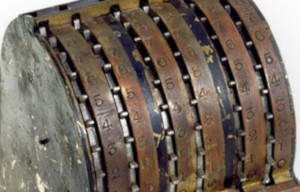
Dr. John Ballou Newbrough (1828-1891), a 33rd degree Mason, clairvoyant, vegetarian, and an avid student of the world’s religions, called by some people America’s Greatest Prophet, was an inventive man and a holder of numerous US patents, between them three patents for calculation devices. The first patent he took out..Read More
Caroline Winter

On 12 April 1859, a certain mysterious person, named C. Winter, of Piqua, from the county of Miami and the State of Ohio, received the 3-page US patent №23637 for Improved Adding-Machine, which was the fourth in the USA keyboard adder, after the machines of Parmelee, Castle and Nutz, and..Read More
John Campbell
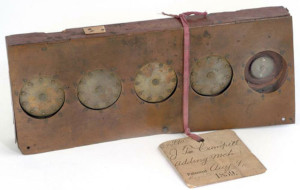
On 9 August 1859, the young carpenter, student, and teacher from Rockville, county of Parke, Indiana, named John Tenbrook Campbell (1833-1911), obtained a patent for a simple five-positional adding device (so-called Addition Machine), similar to these of the earlier French inventors Jean Lépine, and Hillerin de Boistissandeau from the 1720s...Read More