

Victor Schilt
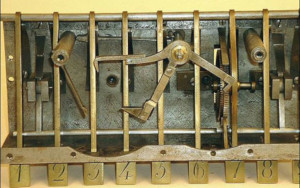
The calculating machine of the Swiss clock-maker and precision-mechanic Viktor (or Victor) Schilt (1822-1880) was exhibited in 1851 at the Great exposition of the works of industry of all nations in Crystal Palace, London, and received an honorable mention and a bronze medal, placed after the calculating machines of Izrael..Read More
William Haines
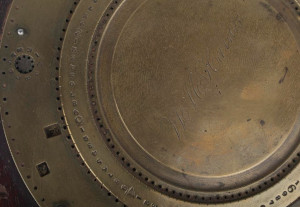
In 1849, William M. Haines, a clerk from Rochester, New York, patented a simple mechanical calculator (US patent No. 6403). The patent model of the device (up to 1880, the US Patent Office required inventors to submit a model with their patent application) is still preserved in the National Museum..Read More
Samuel Young
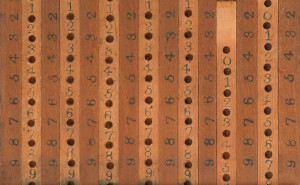
In the middle of the 19th century, Samuel S. Young of Eaton, Ohio, USA, patented three simple (and quite similar) calculating devices. The first patent (US patent No. 6602 from 24 July 1849) was for а machine for adding figures. The second patent was for a machine for calculation of..Read More
Dubois D. Parmelee
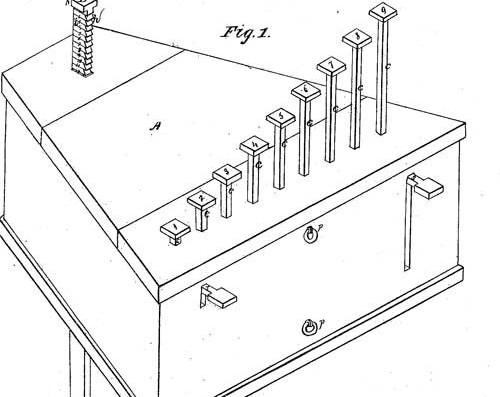
In 1850 Dubois D. Parmelee, a 20-year-old student at New Paltz Academy (later the State University of New York), patented a calculator, which seems to be the fourth key-driven adding machine in the world (after the machines of James White, Luigi Torchi, and Jean-Baptiste Schwilgué), thus putting the foundation of..Read More
John Nystrom

The Swedish born, American civil engineer, inventor, and author John William Nystrom (1825–1885) (born as Johan Vilhelm Nyström) is known as the author of many books and inventions, among them, an interesting calculating device (a slide rule, a type of mechanical analog computer), invented in 1848 and patented on 3..Read More
Aaron Hatfield
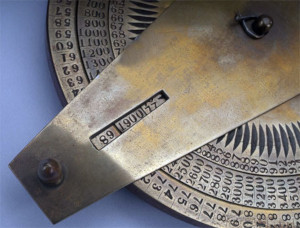
On 26 September 1854, a certain Aaron L. Hatfield of Lewisburg, Pennsylvania, took out a US patent №11726 (see the patent of Hatfield) for a machine for adding numbers. The adding machine of Hatfield, the inventor and manufacturer of adding machines who flourished in the middle of the nineteenth century,..Read More
James Appleby
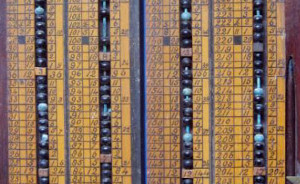
In the 1850s James R. C. Appleby, a linsey maker and hosier from Shaftesbury, Dorset, England, devised a simple stylus-operated calculating device (kind of a simple money abacus), a model of which managed to survive to our time (see the lower images). he adding device of Appleby has the following..Read More