

Wolfgang von Kempelen
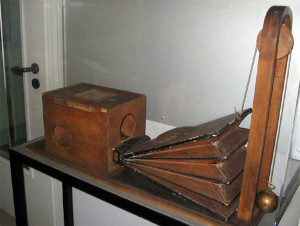
The Austro-Hungarian versatile nobleman, scholar, architect, and inventor, Wolfgang von Kempelen, was mainly known for his fraudulent chess-playing Turk automaton, created in 1769. The Turk was considered the most famous illusion in history (it was exhibited with great success in Europe and USA until late 1854 when it was consumed..Read More
Johann Helfrich Müller
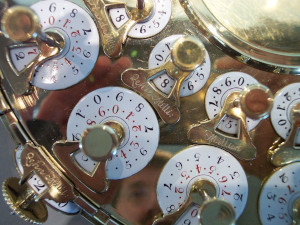
The German engineer and master builder—Johann Helfrich Müller (1746-1830) is a very interesting figure in the world of mechanic calculators, not only for his small calculator, essentially an improved version of the machine of Philipp Matthäus Hahn, which he created but for his plans to build a difference engine almost..Read More
Johann Conrad Gütle
The first man, who was flashed upon to use electricity for calculation purposes, was probably a German mechanic, showman, electrifier and miracle healer, physicist, chemist, teacher, author, and mail order company owner, named Johann Conrad Gütle (1747-1827). Gütle was a self-taught scientist, who from 1780 worked as a traveling experimenter,..Read More
Oliver Evans
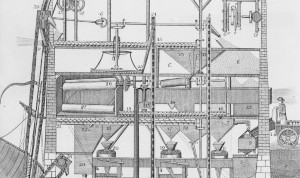
Oliver Evans (1755–1819) was an American inventor, engineer, and businessman, a pioneer in the field of automation, who has been called the first great American inventor the Watt of America. Among his long series of accomplishments was designing and building the first fully automated industrial process in the late 1780s,..Read More
Jacob Auch
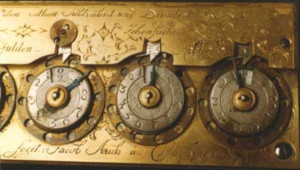
Jacob Auch (1765-1842) was a very good German mechanic and clock-maker, who created about 1790 a calculating machine not of original construction, but of very good workmanship. Auch was born in Echterdingen, a small town in the district of Esslingen, in Baden-Württemberg. In the same town, from 1781 till 1790..Read More
Claude Chappe
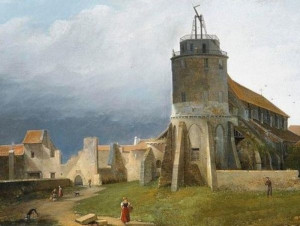
The first widely adopted system for transmitting messages overland and the first practical telecommunications system of the industrial age was developed around 1790 in France by Claude Chappe and his four brothers (Claude was one of eight brothers, but three of them died in infancy, so five survived: Ignace (1762-1829),..Read More
Johann Reichold
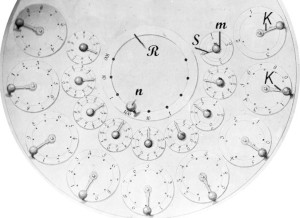
The German pfarrer Johann Reichold (1753-1798) was a bright-minded parson, who was not so interested in theological problems but preferred to spend his time studying and lecturing sciences, especially philosophy, mathematics, and engineering. In 1792 he devised a very interesting arithmetische maschine (arithmetic machine), rather similar to the device of..Read More
Johann Christoph Schuster
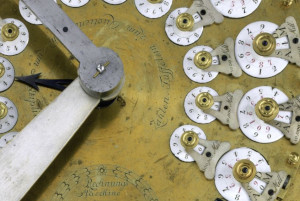
At the end of the 1770s, the Württemberg pastor and genius engineer Philipp Matthäus Hahn hired for his workshop in Kornwestheim as an apprentice the young Franconian Johann Christoph Schuster (1759-1823). Schuster remained in Hahn’s workshop for two and a half years, then in 1785 he married his sister Maria..Read More
Johann Jakob Sauter
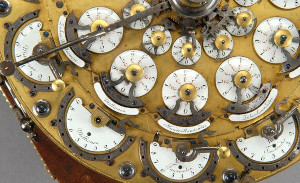
In 1767 the pastor (and self-taught genius engineer) of Onstmettingen village in Württemberg—Philipp Matthäus Hahn designed, and together with his friend and local schoolmaster Philipp Gottfried Schaudt constructed a big brass and iron astronomical clock, presented to Duke Karl Eugen, the Herzog of Württemberg, who admired the inventor and ordered..Read More