

Clarence Locke
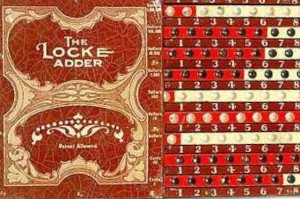
Clarence Elmer Locke (1865-1945), a civil engineer and businessman from Kensett, Iowa, USA, was a holder of two US patents for a simple calculating device—slide bar adder, which became popular as Locke Adder. The first patent was granted on 24 December 1901 (US pat. No. 689680), and the second (No...Read More
Ryoichi Yazu
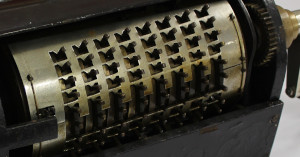
In his short life, the Japanese inventor Ryoichi Yazu (1878-1908) was mainly interested in the mechanics of flight and at the end of the 1890s designed one of the first airplanes in the world, but remained best known for his invention of Japan’s first mechanical calculator (in fact, there is..Read More
Judah Levin
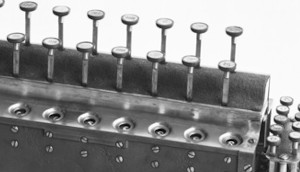
At the beginning of the 20th century Judah Levin (1863-1926), an Orthodox rabbi from Detroit, Michigan, devised three calculating machines, which he patented from 1902 until 1906. A working model only of the third calculator of Levin survived to our time, and it is kept in the collection of the..Read More
Halcolm Ellis
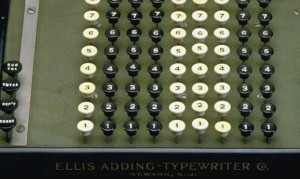
In 1893 Halcolm Gordon Ellis (1867-1925), a young lawyer from Springfield, Mass., was hired to work as a patent attorney for Knight Brothers in St. Louis, later joining the Office of Jury Commissioner. It seems at that time Ellis began inventing himself and soon became a resourceful and talented inventor...Read More
Justin Bamberger
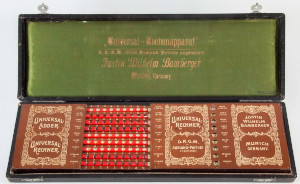
In 1901 the young German inventor and businessman Justin Wilhelm Bamberger (born 20 August 1879 in Würzburg) moved from Cologne to Munich, where in 1902 he registered a company for office equipment, under his name, and also started a small repair shop that dealt with used typewriters. Presumably, he also..Read More
James Dalton
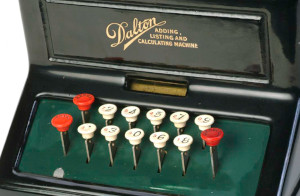
James Lewis Dalton (1866-1926) was a successful businessman and amateur mechanic from Poplar Bluff, Butler county, Mo. He was the owner of the largest department store in the Midwest, a member of the Missouri legislature, and District Deputy Grand Master of the Masonic Lodge of the State of Missouri. How..Read More
Mathias Bäuerle
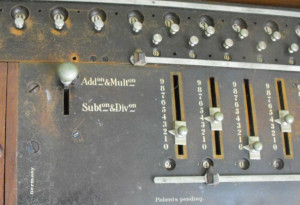
In 1903, the German clock manufacturer from Schwarzwäld—Bäuerle Uhrenfabrik (Clock Factory), Sankt Georgen, launched his adding machine Peerless, which soon became quite popular and won gold medals at exhibitions in St. Louis (World’s Fair of 1904), Liège (1905), and Milan (1906). The founder of the company—Mathias Bäuerle (1838-1916) from St...Read More
Oliver Johantgen
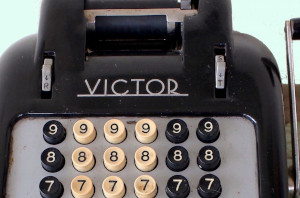
Victor Adding Machine Co. was established in Chicago on 8 Mar 1918, by three men: Oliver David Johantgen (1874-1932), an engineer with a long (since 1896) experience in the field of mechanical calculators and a holder of numerous patents in the USA, France, and Germany, who was the chief designer..Read More
Charles Wales
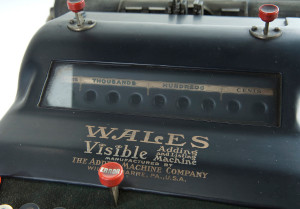
Charles Wales, a genius of mechanical motion and a native of Maryland, who lived in the early 1900s in Detroit, filled his first patent application for an adding machine in September 1902, and when in 1903 the US patent No. 745539 was granted, he decided to establish a company to..Read More
Arthur Postans
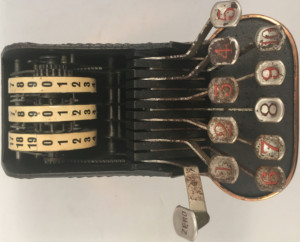
The British engineer Arthur James Postans (1867-1940) from South Kensington, London, applied for a patent for an adding machine in 1902 in several countries. The British (patent No. 190224868), French (pat. №339441), and German (DE169346) patents were granted in 1904. The next year Postans obtained a US patent also (US..Read More