We should be too big to take offense and too noble to give it. Abraham Lincoln
The Italian engineer and University professor Carlo Fossa-Mancini (1854-1931) was a talented hydro engineer known primarily for the design and building of an aqueduct in his native valley dell’Esino, and for his studies on the hydraulic ram.
The English patent drawing of the machine of Carlo Fossa-Mancini
For us Carlo Fossa-Mancini is interesting mainly concerning the creation of the adding machine Indispensable in the early 1890s (probably in 1893, the first (Italian) patent was granted in 1896). In 1898, at the Exposition Nazionale di Torino, the machine was awarded a gold medal for “it can make additions of any number easily and in a very short time”.
The adding device of Fossa-Mancini was patented in Italy (patents №№ IT42837 from 1896 and IT49628 from 1898), France (FR272735 from 1897), and Great Britain (GB189904489 from 1899). The English patent presented not only the stylus set input mechanism but also a key-driven input mechanism (see the nearby drawing).
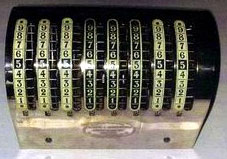
The calculator of Fossa-Mancini is an eight-place adding machine, set by a stylus (or by keyboard), similar to the earlier calculating devices of Americans Joseph Harris, Milton Jeffers, Jabez Burns, and John Ballou. It is a wood and metal-made device, 20 cm long, 12 cm wide, and 13 cm high, with a weight of 1950 grams. Its dials were placed not on the same plane on different vertical axles, as it was in the Pascaline, but vertically arranged on one common horizontal shaft.
The Indispensable adding machine of Carlo Fossa-Mancini
The individual numeral wheels are printed with four groups of the digits 0 to 9. Entering the individual values is made by pulling down the respective numeral wheels of the number to be added until encountering a positive stop. The respective sums of the entered numbers appear in the windows in front of the machine. The last numeral wheels to the left cause a bell to sound with every quarter revolution as a sign that the capacity of the device has been exceeded.
Fossa-Mancini designed the mechanism of the tens-carry originally, somewhat similar to the sautoir of the Pascaline. To facilitate the multiple tens-carry actions (e.g., during adding 99999999+1), which will require huge friction and moments of inertia to be bridged over, Fossa-Mancini provided a massive crook (marked with c on the patent drawing) with a catch (d) for each wheel. The crook is pressed against the gear wheels through a helicoidal spring (m). Every time a wheel is advanced by one tooth, its crook rises slightly. When you go 9-0, the catch falls (pressed by the helicoidal spring) on the next wheel to the left and gives him a blow sufficient to advance it to 1. In addition, there is a tricky mechanism, refined enough to prevent the advance from being excessive. So when the operator has 999999 and adds 1, he will hear a rapid ticking of all the wheels and take forward without effort, as by magic.
The factory of company Japy Frères & Cie
Despite his robust and reliable construction, the adding machine of Carlo Fossa-Mancini didn’t become a best-seller. It was in production for several years, starting from 1900, in the factory of the French company Japy Frères & Cie (manufacturer of clocks, coffee grinders, typewriters, enamelware, kitchen utensils, office machines, etc.) in Beaucourt, a small village at the end of the principality of Montbéliard (see the nearby image). It seems only a few hundred adding machines have been produced.
The Indispensable does not seem to have achieved market success and production soon came to an end, but decades later Fossa-Mancini’s design was resumed by several producers in Italy (Brevetti Lanza’s Addipresto), Germany (Addi, Comet, Argenta), USA (American Adder, Todd-Star, Little Geant), Japan (Addimat), Switzerland (Simex Caroline), and Hong Kong (Swift Handy), until the mid-1960s. All those clones were cheap, reliable, and easy to use.
Biography of Carlo Fossa-Mancini
Palazzo dei Conti Fossa Mancini, Castelplanio (Photo: Diego Baglieri)
Carlo Fossa-Mancini was born on 29 October 1854 in Jesi, Ancona, Italy, to a noble and wealthy family, owners of lands, houses, and a castle in the nearby village of Castelplanio (AN). His father, Raffaele Fossa, a member of the first City Council of Jesi in the new Kingdom of Italy, married in 1852 to Enrichetta Mancini, thus creating the branch of the Fossa-Mancini. Raffaele and Enrichetta had three sons—Carlo, Eugenio, and Adolfo (but only Eugenio had children, and his son Enrico Fossa Mancini (1884-1950) became a famous Italian geologist).
Nowadays, the family home of Fossa-Mancini (the eighteenth-century Palazzo dei Conti Fossa Mancini) in Castelplanio was taken over by the municipality and is now the town hall. A small museum displays memorabilia from the family, furnishings, and one of the few surviving copies of the Fossa-Mancini adding machine.
Carlo Fossa-Mancini was several years a professor at the University of Pisa, and he was the author of quite a few scientific treatises and books, for example, Theory of the hydraulic ram (1890); Study on the rotary pump (1891); On the apparent motion of the plane of oscillation of the pendulum (1891); Irrigation and drinking water in the valley dell’Esino (1893); A critical study on Poynting’s theorem (1912); Theory of the hammer (1915); Rotation of a solid system about an axis (1916); What the war teaches us (1920), etc.
Carlo Fossa-Mancini was also very active in local political and administrative life, becoming, among other things, mayor of Castelplanio from 1913-1914. He spared his time for religious works and charity, and he founded the branches of the Catholic charitable organization Conference of San Vincenzo di Paoli in Jesi and Castelplanio.
Carlo Fossa-Mancini never married and died on 28 November 1931 in his hometown, Jesi.
Lee Burridge (left image) and Newman Marshman (right)
Lee Spear Burridge (1861-1915) and Newman Russell Marshman (1846-1930) of New York were American inventive geniuses and manufacturers, who worked together between 1882 and 1897, and are primarily known as typewriter inventors, but they patented also quite a few calculating devices.
At the beginning of the 1890s Burridge and Marshman devised and patented two adding machines (US patent No. 513452 for Adding Machine from 23 January 1894 and US patent No. 553331 for Adding and Recording Machine from December 1896). Burridge and Marshman patented also a cash register in December 1896 (US patent No. 574302), and Burridge alone obtained also a patent for a cash register in 1898 (US patent No. 608509). Just before his early death in 1915 Burridge returned to inventing calculating devices and he received several other US, France, and Great Britain patents for adding and recording machines (US patents No. 1198820 and 1198821, and GB patent 191409871, FR patent 506256).
The drawing from patent No. 553331 of Burridge and Marshman
Let’s examine the operation of the second calculating (adding and recording) machine of Lee Burridge and Newman Marshman, using the patent drawing (see the nearby drawing).
The object of the invention is to provide a machine that will print and add figures by the operation of a stylus as exemplified in patents on typewriters granted to the inventors in 1885 (US patents No. 314996 and 315386), this invention being the outgrowth of that, and an adaptation of it modified to serve the purpose for which it is intended.
The operation consists in moving the stylus opposite to the desired numeral on the letter-plate and depressing it, which will cause that numeral to be printed on the platen (marked with 51 on the patent drawing), and the wheel 90 (and whatever wheel (31 it is in mesh with) to rotate that particular number of teeth. When the hand and stylus return, the carriage will take one step to the right, owing to the movement of the spring-clogs 76 with rack 75, and the next depression of stylus will cause a numeral of a higher numerical order to be printed and added.
When the desired number has been printed the arm 15 is drawn down, which will cause the carriage to be returned to the starting point, spring 91 to be rewound, the paper to be advanced to a new line, and arms 67 to be reset, it let off during the rotation of the adding-wheels 61.
Biography of Lee Burridge
Lee Spear Burridge was born in Paris, France, on 22 September 1861, the second son in the family of Dr. Levi Spear Burridge (1829-1887), a noted American and European dentist, and Emma Frances (Ogden) Burridge (1821–1881).
Lee’s father, Levi Spear Burridge (see his portrait below), was born on 15 July 1829, in Painesville, Ohio, United States, as the eight (of nine) children of Samuel Burridge (1784-1864) and Hannah (Parmly) Burridge (1792–1891). Levi was a nephew of (and was named after) Dr. Levi Spear Parmly (1790-1859), an influential American apostle of dental hygiene, and grandson of John Burridge (1756-1815), who came from England in the 1770s, settled at Braintree, Massachusetts, and took part in the American Revolutionary War.
Levi Burridge graduated from high school in his home town Painesville and later studied at the just founded seminary in the nearby town of Madison, Ohio. Then Levi enrolled at the Baltimore College of Dental Surgery to study dentistry and graduated in 1850 as D.D.S. (Doctor of Dental Surgery). A year later, in 1851, Levi received an M.D. at the Baltimore College of Physicians and Surgeons.
Levi Burridge (1829-1887)
After two years of practicing in New York with his uncle Dr. Eleazar Parmly (1797-1874), also a dentist, Levi traveled to Rome, Italy, where he established his headquarters for 17 years. In Rome, in 1854 he met, and next (1855) year he married Emma Frances Ogden (born on 15 February 1821, in Bordeaux, France—died 11 Jan 1881 in New York), a daughter of Samuel Gouverneur Ogden (1779-1860), a wealthy American merchant. They had a daughter, Emma Frances (1856-1880), and two sons, Francis (Frank) Ogden (born in Rome, 5 February 1858—died 25 September 1930) and Lee Spear. Levi practiced mainly in Italy, Austria, and France (he settled in Paris in 1869, took part in Franco-Prussian War as a surgeon, and was awarded), and his patients were many local celebrities like the Rothschild family, Pope Pius IX, the King and Queen of Naples, the Emperor and Empress of Austria. In 1879, Levi settled down and since then has been commuting between Europe and the USA. He died as a result of an accident (falling from his carriage) on 28 November 1887, in Cannes, France, and was interred in Woodlawn Cemetery, New York.
Lee Spear Burridge spent his youth in Europe (he was educated at Tunbridge Wells Grammar School, south-east of London, England) and in 1878 he moved to New York, entering the importing house of Aufmordt & Co. Being of an inventive turn of mind (in 1883 the American Institute granted him an award of merit), he directed his attention to the manufacture of mechanical toys and in 1890 established the Sun Manufacturing Co. to exploit these novelties. Among his toys were a walking man and a creeping doll, which were marvels of ingenuity.
Lee Burridge directed much of his efforts at simplifying the parts and movements of the typewriter, a technological novelty in those days. Some of his innovations over the years were: a new inking system combining a small self-supplying ink roll with a type-bar; a counter-balance type bar, permitting a very slight and delicate touch to the keys; a visible machine; a special type-bar machine operating 78 characters with only 10 keys (however, this odd machine was never produced.
The Sun Index typewriter of Marshman and Burridge
In 1882 Burridge began a long-lasting partnership with another inventor—Newman Marshman. They combined to work on a toy and jointly patented it (US patent No. 296724) in 1883. In 1884 they devised the Sun Index typewriter. In 1885 it was patented (patent No. 315386) and went into production (see the nearby image). In 1887 Lee and his brother Frank incorporated the Sun Typewriter Co. in New York. Lee was president of this company until his death.
The Sun Index was very successful and the sizeable profits it made allowed Burridge and Marshman to be kept almost fully occupied for the next 12 years. During this time, Burridge and Marshman produced and tested 685 prototypes as they tried to perfect a typebar typewriter.
After patenting several calculating devices in the early 1890s, in 1896 Marshman and Burridge offered a swinging type shuttle typewriter to the American Typewriter Co., but it failed. Soon after this failure, they went their separate ways.
The SUN typewriter No. 2 of Lee Burridge
Lee Burridge is well known to the typewriter industry because of the machine he and Frank launched in 1901, the Sun No. 2. This remarkable machine (see the nearby image) was an early luggable, came in its own case, and was advertised as the only standard typewriter suitable for travelers. It is a small desk machine with an idiosyncratic inking mechanism, that sold quite well from 1901 to 1907.
Sun keyboard machines were fairly successful and quite a few were made, and they were made up until the early 1920s. Lee Burridge never married but did manage to leave behind at least three small Suns, the index model, and the two keyboard models. Moreover, after his death, in 1919, Underwood Co. bought the patents for Burridge’s machine and launched it in November 1919 as the Underwood Standard portable Typewriter.
In 1908 Burridge became interested in aviation and together with some like-minded enthusiasts purchased the first airplane ever sold. He arranged the first public exhibition of flying that was given by Curtiss at Bronx Park. This airplane was sent on an exhibition tour throughout the United States and Canada, solely to foster and create public interest in aviation, and was in a large measure the start of practical aviation in the USA.
Lee Burridge was a remarkable inventor, he applied for and received over sixty patents and constructed nearly seven hundred different models. Moreover, he founded the Aeronautical Society of America and was the president for several years. Burridge was also a member of the Aeronautical Engineers Society, the Automobile Club of America, the National Geographic Society, and the Aero Club.
Lee Spear Burridge died at age 54 at his home on 160 West 54th Street in New York, on 4 May 1915. At the time of his passing his estate was appraised at $91,000. Unmarried, Lee left this small fortune, and his unassigned typewriter patents, to his brother Frank.
Biography of Newman Marshman
Newman Russell Marshman was born on 19 December 1846, in Manhattan, New York. He was the son of an English-born real estate agent, Benjamin Marshman (born 1810), who emigrated to America in the 1830s, and his Pennsylvania-born wife, Rachel Newman Marshman (b. 1812).
The Orguinette of Newman Marshman
According to the 1850 US census Newman was living with an aunt, Ellen Marshman (b. 1815), and his two brothers, Benjamin (b. 1842) and Robert (b. 1847). Despite being young, in 1864-65 he took part in the American Civil War. In 1870, aged 24, and with his whole family now reunited, Marshman was working as a clerk in a store.
In the late 1870s he worked as a professor of music. At that time he devised the orguinette (see the nearby image), a small portable reed organ mechanically played by turning a crank (Marshman got three patents for this device, in 1878, 1882, and in 1884). This type of musical devices have an important place in history as the first affordable instruments for the mass distribution of recorded music. The music was recorded on paper sheets or rolls, cardboard disks, or pinned wooden cylinders. The organettes were made in big quantities and in a great variety of styles, beginning in the late 1870s and continuing until superseded by the gramophone in the early 1900s.
In 1878 Marshman invented a player harmonica (US Patent No. 209492), the music for which was “written” as a series of holes punched in a roll of paper. The player blew into the mouthpiece while turning handles that wind the paper roll through the instrument, determining which notes are to be sounded.
In the early 1880s Marshman continued working in this area, and in 1881 he invented a flute organ, followed by yet another musical instrument in 1883.
The Toy Theater of Newman Russel Marshman
By 1881 Marshman had moved on to toy inventing, in particular a Toy Theater or Punch and Judy Show (see nearby drawing), which he patented in 1882 (US patent No. 256909).
In 1882 Marshman began a long-lasting partnership with Lee Burridge, which continued until 1897 when they went their separate ways. In the late 1890s Marshman made three attempts to come up with his own typewriter, and obtained three patents for typewriters, and for an inking ribbon for typewriters, but apparently without success. Later he patented a coal-carrying vessel or bag (1905), a sweat band for hats (1908), etc. In 1910 Marshman returned to his first pursuit, musical instruments inventing, but by 1915, aged 69, he was out of work.
In 1873 Newman Marshman married Josephine Marshman (born Sep. 1853). They had three children, but all of them died in infancy.
Despite being an inventive genius, at the end of his life, Newman Russel Marshman was a penniless servant in the Baptist Home for the Aged in New York City. He died in Bronx, NY, at the age of 83, on 2 November 1930, and was buried in Poughkeepsie Rural Cemetery.
From 1896 to 1912 George Wilson Dudley from (West) Virginia was granted numerous (at least 15) patents in the USA, Canada, France, Spain, and Great Britain mainly for adding and printing machines, as well as for attachments for adding and tabulating for typewriters, method, and machine for writing in cipher, and for a vehicle wheel.
The Adding and Printing Machine of George Wilson Dudley. The illustration is from Scientific American Magazine and represents a double machine, upon one side of which can be kept the debts and on the other the credits, and a balance can be struck by deducting the one from the other.
Most of the patents (beginning with the first patent of Dudley, US patent No. 554993) were assigned to Numerograph Manufacturing Company of Charleston, West Virginia, and were manufactured by this company in small numbers at the end of the 19th and beginning of 20th century. The Dudley Typewriting and Adding Machine, (a.k.a. Numerograph) (US patents No. 554993, 555038, and 555039) was a very interesting, substantial looking machine, and it was presented in the No. 21, 23 May 1896, issue of Scientific American Magazine (see the nearby illustration of page 328).
Let’s examine in short the calculating machine of George Dudley, using the patent drawing (see the patent drawing below).
The object of the device is to quickly and accurately add a column or columns of figures, and at the same time and by the same manipulation of the keys to print upon a sheet of paper these figures in the order in which they are added, so as to form a proof-sheet which shall verify the correctness of the addition. The machine by special adjustments may be made to print at the bottom of the column the sum total of the column, and to do this work in a vertically descending progression or vertically ascending progression, or in a horizontal progression.
The patent drawing (US554993) of Adding and Printing Machine of George Dudley
The machine has eleven operating keys. The first one, (marked with D on the patent drawing), on the left bears zero (0) and is not connected with the adding mechanism, but only with the printing mechanism. The middle keys, B, are nine in number and bear on their faces the numerals 1 to 9, and all have the action and connections, and all operate both upon the adding and printing devices when depressed. The key N on the extreme right is the spacing-key and has no connection with the adding wheels, but only cooperates with the paper-feeding mechanism and has its own peculiar connections.
The machine verifies, by printing in full sight, each figure to be added at the same time the addition is made, and is so constructed that, if the proper key is struck, the result must be perfect. It works with the ease of a typewriter and its speed is only limited by the skill of the operator. It subtracts by reversing the machine as readily as it adds; in other words, the registering disks run one way as readily as the other. It carries automatically. The keys all work in the same horizontal plane and have for each figure the same dip or extent of depression. Its construction is simple, considering the variety and extent of work done, and its action in all its parts is positive. It is adapted to printing on passbooks with the same facility as upon the ordinary platen and sheet. Additions can be made either to the right or to the left. It can be used to add without printing or to print without adding. Mistakes, if made, can be seen at once, and corrected as easily as mistakes upon the typewriter.
In 1895 George Calder Jr. (1830-1897), a prominent businessman, self-taught mechanical genius, and inventor of Lancaster, Pennsylvania, obtained a patent for cash register and indicator (US patent No. 543980). Except for the patent application, nothing is known about the calculating device of Calder, so obviously it remained only on paper and had not been implemented in practice. In fact, Calder tried to arrange the manufacture of his patented cash register, but without success.
The patent drawing of George Calder’s cash register
Let’s examine in short the calculating machine of George Calder, using the patent drawing from US543980 (see the nearby image).
The numeral wheels are four in number and correspond to units, tens, hundreds, and thousands.
The mechanism can be used for registering and adding pounds, shillings, and pence, or any denominations of currency or measure having a determinate relative value, by suitably engaging the teeth in the various gears and otherwise modifying the parts in the usual manner.
If the units-wheel (marked with 18 on the patent drawing) has been rotated three times, the digit 3 will be indicated on the tens-wheel 40′, said wheel having been moved three times by three complete rotations of shaft 24 and wheel 40, each movement of the wheel (marked with 40′) being the tenth of a rotation. If, however, tens are to be indicated by the second or tens wheel 18—for example, three dimes—the second key and lever 24 and the corresponding wheel 18 will be moved, which will have the effect of moving the second shaft 34 and numeral-wheel 40′ three-tenths of a rotation and so as to indicate 3, and this is effected without the intermediate agency of the first shaft 34 and its operating-bar.
At the end of the business day or at any time desired the several numeral wheels can be set at zero by means of the shafts 34, which project through plate 39′ for the purpose.
Biography of George Calder
George (Edward) Calder Jr. was born on 28 May 1830, in Boston, Massachusetts, as the oldest son of George Calder and Martha Ann Calder (born Leland).
George Calder Sr. (born on 29 November 1799, in Gloucester, Essex, MA) was a prominent Lancaster businessman, who had charge of and ran steamboats from Lancaster to Philadelphia in the 1840s and later was a coal merchant. He was the 4th generation heir of Dr. Robert Calder (1692-1746), born in Scotland, who emigrated to America in 1710 and was a surgeon at the Royal Navy. George Calder Sr. died on 21 July 1884, in Lancaster.
On 6 December 1827, in New York, George Calder Sr. married the young Martha Ann Leland (born on 15 April 1809, in Boston, MA, died 4 August 1903, in Lancaster), daughter of Lewis Leland and Martha (Patty) Smith. The family had (besides George Jr.) three daughters—Martha Ann (1828-1875), Mary (b. 1832), Euphrasia Emiline (1836-1911), and four younger sons—William (1831-1847), Francis Leland (1838-1913), Lewis Augustus (1840-1841), and Lewis H. (1843-1866).
George Calder Jr. moved with his parents to New York when a child, afterward in the late 1830s for several years they moved to Montevideo, South America, before returning in 1840 to the USA and settling in Lancaster, Pennsylvania. When only eighteen years old George went to California in the late 1840s and accumulated a small fortune. In the early 1850s, he worked as a clerk in California and came back to Lancaster around 1852, and has since resided there.
In 1862 George Calder enrolled 79th Pennsylvania Volunteer Infantry and took part in the Civil War.
In the late 1850s, George Calder was for several years in the employ of his father in his steamboats and coal business, before starting his own business. In 1866 he built (together with William Martin Wiley(1825-1874), another local businessman) a cotton mill in Lancaster and continued the business until 1889. In 1892 Calder started another cotton mill in Lancaster. He was also the owner of a cotton mill in Harrisburg, which he operated for ten years. He was for fifteen years the proprietor of a dye house, which was operated in connection with his mills.
George Calder was a mechanical genius, and besides the above-mentioned patent for calculating machine, he was a holder of several patents for matrix-making machines. He had the first telephone in Lancaster.
George Calder was engaged in charity, he was on the Board of Trustees of the Yeates School in Lancaster (institution for education of poor young men for the ministry), and in 1859 one of the incorporators of the Home for Friendless Children.
George Calder married Mary Maris Hurford, daughter of Lewis Hurford (1784–1862) and Sarah Downing Couch (1811–1900), on 28 April 1863, in Lancaster, Penn. Mary Maris was born on 23 May 1838 in Lancaster and died on 21 April 1928. They had six children: Ellen Ellery (1865-1902), George Hurford (1867-1935), William Ellery (1870-1920), Mary Hurford (1872-1958), Edward (1875-1944), and Stewart Wilson (1878-1920).
George Calder Jr. died at age 66 at his residence, No. 221 East Orange Street in Lancaster on 11 March 1897. The cause of death was dropsy and kidney trouble. He was buried at Woodward Hill Cemetery.
“Klieg, Klieg, Klieg—Du bist a Nar. You are smart, smart, smart—but you are not so smart!
A Yiddish saying
In the late 19th and early 20th century Charles Schachan Labofish (1861-1925), a machinist and Jewish immigrant from Odessa, Russian Empire, who came to America in 1888, devised various machines (calculating machines, typewriters, log-sawing machine, cyclometers, indicating device for bicycles, brush-machine, gage, etc.) and received some fifteen US, Canada and Great Britain patents for his devices, six of them for calculating machines (US533361, US544360, US661058, US673877, CA51938, and GB190101736).
For his first patent for calculating machine Labofish applied in December 1893, and the patent was granted in January 1895 (see the lower patent drawing). The first two patents for calculating devices of Labofish are describing a watch-like adding machine. Let’s examine the first calculating machine, using the patent drawing of US patent No. 533361.
The object of Labofish’s invention is to produce a very simple and efficient calculating machine, which may be made in the form of a watch and conveniently carried in the pocket, which operates without keys and is not likely to get out of order or make mistakes, and which may be easily operated to perform the various operations in addition, subtraction, multiplication, and division.
The device has several number wheels (marked with 16 in the drawing), each number wheel having on its face concentric rows of figures from 0 to 9, the rows being arranged in reverse order, with their 0’s on the same radial line as shown clearly in Fig. 2, and the rows of figures on each wheel are dissimilar, preferably both in style and color, so that one row may be readily distinguished from the other. The object of this reverse arrangement is to enable one row of numbers to be used in addition and multiplication, and the other row to be used in subtraction and division. The number wheels are arranged to represent units, tens, hundreds, etc., as in Fig. 1 are shown seven of them, but any necessary number of wheels may be used.
The patent drawing of the first calculating machine of Labofish (US533361)
In order to provide for carrying “one” in working the machine, it is necessary to have means for turning one wheel a distance of one number at each rotation of the adjacent wheel representing a lower denomination, and to this end each barrel 17 has on one side a projecting stud or tooth 26, which is adapted to engage the notched or forked end 27 of a lever 28, which is pivoted on the base 19 just below the pinion 23, and the lever projects over the next adjacent base and is provided with a pivoted pawl 29, which is adapted to engage the pinion of the next number wheel, the lever and its pawl being held in engagement with the stud and the pinion by springs 30 and 31.
The machine is operated by turning the crown head 34 to the right, according to the numbers to be added, multiplied, subtracted, or divided. In operating the machine, the number wheels to be moved are pressed inward by pushing one of the push buttons 22, thus throwing its pinion 23 into gear with the driving gear 24, and then, by turning the crown head 34, while the pinion is held in gear with the gear wheel the appropriate number wheel is rotated.
Let’s suppose, for instance, that the number 341 is to be added to the number already indicated on the face of the machine. The push button 22 opposite the units slot is pushed inward, thus throwing the units pinion 23 into engagement with the gear wheel 24, and the crown head 34 is pushed inward slightly and turned to the right a distance of one number, thereby turning the units wheel a corresponding distance by means of the gear connection described, and if the number 5, for instance, has been previously shown in the said slot over the units number wheel, the number 6 will now appear and, after this, the pressure on the push button is removed and the crown head pulled out slightly so as to release it from the spring detent 38 and permit it to return to its normal position. The push button of the tens wheels is then pushed in, thus throwing the tens number wheel into gear and the crown head is then turned a distance of four numbers, thus moving the tens number wheel a corresponding distance and adding 4 to the amount already shown in the tens sight slot. The operation is then repeated on the hundreds number wheel, this being turned at a distance of three numbers and the sum is then registered and exhibited in the sight slots. If the sum of any two numbers exceeds ten, tooth 26 of the number wheel, being operated, is brought into engagement with the lever 27 which is tilted and turns the next number wheel of a higher denomination one notch or number. The sums in addition are exhibited by the inner row of figures in the sight slots, and if subtraction or division is performed, the result is shown by the outer row of figures.
In subtracting, the operation is exactly as in adding, except that reference is made to the outer row of figures in the sight slot, and if the crown head is turned to the right the outer row of numbers diminishes at the same rate that the inner row increase. If then the number 341 is to be subtracted from the number already shown on the dial of the machine, the same steps are taken as above described, but in the units, tens, and hundreds sight slots numbers will appear which are 1, 4, and 3 respectively, less than the numbers previously shown.
The patent drawing of the second calculating machine of Labofish (US673877)
As multiplication is successive additions and division successive subtraction, it will be readily seen that these operations may be performed by simply turning the crown head in a manner to repeat the additions or subtractions.
The next two patents of Labofish are describing calculating devices for typewriters (see the nearby drawing from US patent No. 673877).
The object of this invention is to simplify the means used for calculating purposes and to provide sure means of extending the usefulness of such devices by constructing the same so compact and of such a nature and so entirely automatic as to make its application to a typewriting machine perfectly practical, so that the mere writing of a column of figures on the typewriter will simultaneously register and add the said column of figures within the device automatically without encumbering the typewriter in the least.
Biography of Charles Labofish
Charles Schachan Labofish (1861-1925)
Charles Schachan Labofish (Labofitz) was from a possibly German or Ashkenazi Jewish family, but he was born in Odessa, Russian Empire, in April 1861 (most probably as Карл Лейбовиц). He was the son of Eiel Labofitz and Dora Brier. In the 19th century Odessa was an important Russian town with a large Jewish population.
In 1884 Charles married Rose Ethel Rabinovitch-Lamlec, from a well-to-do Jewish family from Odessa. Rose was born on 12 May 1864 (although on her tombstone is specified 1868, and she died on 3 March 1948 in Washington, D.C.), and their first child (William Harry, 1885–1966) was born on 20 December 1885 in Odessa.
In the middle 1880s the family of Charles Labofish led an easy life in Odessa, and Charles worked as a main representative of Singer Corporation, the famous American manufacturer of sewing machines. It was not long, however, before they had troubles.
The Jews in Russia were subject to anti-Semitism, and a series of pogroms (massacres) against Jews in Odessa occurred in 1821, 1859, 1871, 1881, 1886 and 1905. In 1886 pogrom was killed the father of Rose Ethel, a rich local merchant, thus the family decided to leave Russia and seek a more secured place for life.
They spent some time in Dunayevtsy (Dinovitz), another Russian town with a large Jewish population, where on 20 November 1887 was born their second child—Louis Willard (1887–1988). In 1888 they moved to Germany, and soon after immigrated to America, settling initially in New York, then in Pennsylvania and Washington, D.C.
William Harry Labofish (1885–1966)
In the USA the family had two other children—John Paul (1896-1956) and Lillian Ethel (1898-1988). John Paul Labofish became a lawyer in Washington, and he was the grandfather of the famous American actor, filmmaker, and screenwriter Sylvester Stallone.
In the 1890s Charles worked in a bicycle show in Washington as machinist, and invented some devices for bicycles, like cyclometer and indicating device, as well as several calculating devices. Later he turned his inventive mind to typewriting machines and worked for Remington Typewriter Company.
In the early 1900s Charles Labofish worked as a district judge and attorney and counselor in patent causes. In 1911 he published a book, How to win fortune by inventing. He was a keen weightlifter who had shared a room with the bodybuilding pioneer Charles Atlas.
Early in 1916, we found Charles Labofish in Chicago, where he got a divorce from his first wife and later he married Mary Watson Zimmerman (b. 1891:-) on 30 March 1916 in Lake County, Indiana.
Charles Schachan Labofish died on 10 September 1925 (aged 64) in Los Angeles, California.
William Samuel Gubelmann (1865-1959) was a remarkable American inventor and businessman, who held hundreds of USA and Canadian patents, mainly in the field of adding machines, accounting machines, and cash registers. In 1959 Popular Mechanics magazine called Gubelmann the father of all calculating machines in use today. The New York Times newspaper said that his inventions formed the basis of the business machine industry. Gubelmann licensed his inventions to huge companies like Remington, IBM, and National Cash Register, and was involved in substantial litigation later.
The patent drawing of Gubelmann’s adding machine from 1893
For his first patent for adding machine Gubelmann applied in June 1891, and the patent was granted on 31 Oct. 1893 (US patent No. 507810). It was a simple one-column keyboard adder (suitable for adding columns of numbers), with a large registering wheel (see the nearby patent drawing), similar to the earlier adding machine of Caroline Winter.
The patent relates to an adding machine in which a registering wheel or disk containing a row of numbers and enclosed in a suitable casing is rotated by a series of key levers, each key lever being provided with a number. Upon depressing one of the said key levers, the registering wheel is rotated so as to expose, through an opening in the casing, a number corresponding with the number on the key lever, and upon depressing two or more of the key levers, successively, the number representing the numbers on all of the key levers depressed added together will be indicated on the registering wheel through the opening in the casing.
One of the most famous patents of Gubelmann was US1429201 from 1922 (Interestingly, the inventor needed more than 22 years to get this patent). It was for an adding and recording machine with a plurality of sets of totalizer wheels and an associated printing mechanism capable of printing items introduced into the sets of totalizer wheels, and also of printing totals under the control of either of the sets of totalizer wheels. It was further characterized by a mechanism whereby items introduced are printed, a subtotal may be printed, and the subtotalizer cleared, without disturbing the amount standing on a grand totalizer.
Biography of William Gubelmann
Rev. Jacob Samuel Gubelmann (1836-1919)
William Samuel Gubelmann (in his youth known as “Willie”) was born as Gulielmus Samuel Gubelmann in St. Louis, Missouri, on 7 July 1865. He was the son of Rev. Jacob Samuel Gubelmann (1836-1919) (see the nearby portrait), born in Switzerland, and Sophia E. Holste–Gubelmann (1843-1924), born in Germany.
Jacob “John” Gubelmann was born in Bern, and came to America at age of 12 in 1848 together with his father–Rev. Henry Gubelmann (1811-1883). Next year Jacob was converted and baptized in New York, then in 1852 entered Theological Seminary in Rochester, and finally graduated as a doctor of divinity at Rochester University in 1859. Later he served at churches as pastor for 25 consecutive years, in Louisville, KY (1860-1862), St Louis, MO (1862-1868) (where in 1863 he married Sophia Holste, and their first child William was born in 1865), and Philadelphia, PA (1868-1885). In 1885, he was called to Rochester Seminary as a teacher, this place he held for 30 years. Besides William, the family had also Bertha (b. 1867), Albert (b. 1876), and Ella Christine (1880–1950).
William Gubelmann spent his childhood in Philadelphia, PA, where he started his career as an inventor only 19 years old in 1884, when he began working on a model of the typewriter. His first patent (for a cuff retainer, US patent No. 362000) Gubelmann obtained in 1887. His patents have been challenged and claimed thousands of times, but he was one of those rarities, who got rich from patents, as his fortune was derived for some 50 years of royalties on his patents.
William Gubelmann had a passion for yachting and one of his prized possessions was a square-rig, 3 mast, 168-foot yacht called the USS Seven Seas.
William Gubelmann married Juliette E. Metz (1867-1956) in 1891, and they had three daughters: Dorothy Irene (1892–1984), Mildred (1899–1976), and Gladys (1900–1982), and a son: Walter Stanley (1908-1988), who inherited from his father the management of the family held Realty and Industrial Corporation, which was reaping his family millions of dollars.
William Samuel Gubelmann died in New York on 26 September 1959.
Peter J. Landin (1858-1940), a Sweden-born American inventor and businessman, commenced his work on calculating machines in the late 1880s, then living in Minneapolis, Minnesota. In September 1890 Landin applied for his first patent in this area, US patent No. 482014 for Cash Indicator, Register and Recorder. In February 1891 Landin applied for another patent, this time for Computing-machine (US patent No. 482312, assigned to the prominent businessman Thomas Barlow Walker). Both patents were granted on 6 September 1892. Later (in 1894) Landin got several other patents for cash registers (US patent No. 526400, 526401, and 526402), and then switched his inventive mind to other machines.
Landin’s Computing-machine was manufactured between 1891 and 1895 by the company, founded by the inventor himself—Landin Computer Co., Minneapolis, and was marketed under the name Landin Computer (see the image below). Later at the end of the 19th and the beginning of the 20th century, the same device was produced by the Rapid Computer Co., Benton Harbour, Michigan, under the name Rapid Computer Adding Machine. The price at the beginning of the 20th century was $25, a hefty sum then that underscores its market viability. Since 1909 a slightly improved version of the device was produced by Schubert & Salzer Maschinenfabrik AG in Chemnitz, Germany (manufacturer of bicycles and cash registers), under the name Comptator. In 1922 the production was transferred to Hans Sabielny, Dresden, Germany, and the Comptator had a good market success.
The Landin Computer is a seven digital positions slide-chain adder operated with a pin or pencil, but the inventor mentioned in the patent application that I do not limit myself to this or any particular number of slides, as any desired number of slides and ratchet-wheels may be used. It is a well-designed and manufactured device, with robust and reliable construction, with dimensions (mm): 60W x 205D x 32H, and weight: 750 g.
The stylus (operating pin or pencil) is inserted in the toothed slides in the upper section and is drawn down to the stop (marked with 15 on the patent drawing), advancing the register by the corresponding number of places. The slides remain in their final position so that the value entered can be read back for verification in a straight line above the stop. The slides spring back to their home position when released by the lever on the left-hand side. The lever can be latched down to give an immediate return if checking is not required.
The Landin Computer was actually designed for 19th-century bookkeepers and the width of the slides substantially corresponds with the ordinary spacing of an account-book of the time, so the device can be put over the page, and each slide comes substantially in line with the right-hand figure. The machine can be used with any desired number of columns of figures and with any number of sets or rows of figures, and after each set or number has been added the correct sum will be shown by the device. It is particularly useful in transferring from a journal to a ledger, where the sum of each entry as it is made may be registered on the machine, and this sum, when the work is completed, should correspond with the journal footing. This is termed reversed posting.
Biography of Peter Landin
Fletcher Loren Walker (1872-1962), a co-worker of Peter Landin
Little is known about the inventor of this calculating machine—Peter J. Landin. He was born Peter Johan Landin on 9 March 1858 in Sweden. Interestingly, as he was obviously known under the Americanized version of his name Peter John Landin, he was the full namesake of the famous British computer scientist Peter John Landin (1930–2009).
Peter Johan Landin married the Sweden-born Ida Marie Ek (1 Oct 1865–11 Mar 1951) on 4 July 1886. They were the parents of three children, unfortunately, two of them died as babies: Esther Resedith (b. May 1888-d. April 1889), Esther Resedith II (30 Jul 1889-22 Aug 1948), and Allbeen (born and died Feb 1890).
Besides the above-mentioned patents for calculating devices, Peter Landin was a holder of several other US patents: for a phonograph (pat. No. 1422453), for a motion picture film (No. 1234046), for adjustable theater seating, etc. On the patents of many of his inventions, Landin worked for the prominent Walker family, a highly successful American business family, who built one of the largest forest products corporations in the USA at the time (Fletcher Loren Walker (1872-1962, see the nearby portrait) is a witness of the first and a co-holder of the other patents for cash registers, assigned to his father, Thomas Barlow Walker (1840-1928)).
In the 1890s Peter Johan Landin lived in Minnesota (Moorhead and Minneapolis). In the 1910s and 1920s, he lived in Denver, Colorado. He died on 24 January 1940 (aged 81) in Fargo, Cass County, North Dakota, and was buried in Evergreen Memorial Cemetery, Moorhead, Minnesota.
Hugo Cook’s first patent drawing, side elevation and top plan view (pat. 430001)
The Indiana born prominent American engineer, inventor and instrument maker Hugo Cook (1857-1944) was a holder of many US and Canada patents from 1883 until 1925 for various devices (like sewing machine implements, bicycle spokes, autographic register, motor vehicle traction apparatus, etc.), between them quite a few calculators (adding machines and cash registers).
His first patent for registering and adding machine (US patent No. 430001, see the nearby image) Cook got in June 1890 (application filed in July 1889). The device was designed for use by storekeepers and others as a means for accurately registering the amounts or values of sales, and it has its object to simplify and cheapen the construction of devices of this character without impairing their efficiency.
The machine has several key-levers with different values inscribed, and an escapement wheel controlled by each key, with a number of teeth bearing the proper relation thereto. For instance, the illustrated machine has a designated (marked with R’) key as a “five-cent key”, and escapement-wheel I’, controlled by the five-cent key, with twenty teeth, so that the distance between every two teeth representing the twentieth part of one hundred, i.e. the twentieth part of a dollar. So in like manner, there are escapement wheels with ten, five, four, and two teeth, respectively, to correspond with the parts of a dollar which the ten-cent, twenty-cent, twenty-five-cent, and fifty-cent keys represent, respectively. Each key-lever is connected to a spring (marked S), which upon release of the key-lever will react, restoring it to the original position, and releasing the proper escapement wheel.
In 1891 Hugo Cook designed one of the first in the world adding machines (cash register with indicator and recorder, US patent No. 464294) with a crank and printing device. Later he was granted several other patents for cash-registers: US445671, US448937, US449311, US483511, US482165, and CA000000041815A.
Biography of Hugo Cook
Hugo Cook was born on 14 June 1857 in Dublin, Indiana, in a family of German emigrants—Ignatz (1819-1 Dec. 1896), and Mary Cook (1826-1895). Ignatz Koch (Cook is the Americanized version of his surname) was born in Württemberg in 1819, and died on 1 Dec. 1896, in Indianapolis. Mary Koch was born in Baden, Germany (as Maria Stuber) in 1826 and died on 26 June 1895, in Indianapolis. Ignatz Koch (Cook) was a mechanic and in the 1860s worked in a machine workshop in St. Louis, then in the 1870s was a sealer of weights and measures of Indianapolis. Hugo had an elder brother—Julius (b. 1853).
Hugo Cook was educated in the public schools of Indianapolis, and in a technical school in Saint Louis, Mo. He also received instruction in mathematics and surveying from Prof. Stephens, of Indianapolis.
After spending about three years in this line, Hugo Cook turned his attention to the manufacture of sewing machines, in which he was engaged for several years, during which time he invented several machines and made various improvements. He was practically the inventor of the first rotary shuttle machine.
Following this period, Hugo Cook turned his attention to the invention of automatic machinery and placed on the market various machines and devices of that character. For several years he manufactured special machinery, and turned out various automatic screw machines, and also a successful machine for the manufacture of bicycle spokes, etc.
In the late 1880s, Hugo Cook turned his attention to inventing calculating machines, and in the fall of 1888, he went to Dayton with his designs and associated himself with the National Cash Register, for the manufacture of his machines.
In 1895 Hugo Cook organized in Dayton a company for manufacturing gas engines. Cook was president, Charles A. Craighead and William Kinnard were directors. The plant was located at No. 1136 East Third street, and the goods manufactured were from the patents of Cook.
The house of Hugo Cook on 815 Harman Avenue, Town of Oakwood, Dayton, Ohio
Hugo Cook was one of the most skilled and thorough men in the manufacturing business in Dayton, enjoying a reputation in the business world for progressiveness and enterprise, coupled with integrity and sound business principles. He was a member of the Masonic order, being a Knight Templar and a member of Reed Commandery.
In the early 1870s Hugo Cook acquired a large parcel on 815 Harman Avenue, in the Town of Oakwood, today part of the City of Dayton, Ohio, and built initially a carriage house and experimental workshop, in which he spent a large portion of his time. Then in the 1880s he built a beautiful house for his family (see the nearby photo of the house), and lived there until 1906. In Oakwood his neighbors include Orville Wright, the coinventor of the airplane, and John Patterson, the founder of the National Cash Register Co., who used numerous inventions of Cook in his machines.
Hugo Cook married in 1879 Anna Maria Wilmer (b. July 1854—d. 5 Oct. 1901). Hugo Cook died on 2 March 1944, in Indianapolis and was buried in Crown Hill Cemetery.
The term Metaverse was coined in Snow Crash, Neal Stephenson’s 1992 sci-fi novel, and refers to a convergence of physical, augmented, and virtual reality in a shared online space (Metaphysical Universe).
Neal Town Stephenson (born 31 October 1959) is an American writer known for his works of speculative fiction and technology publications. Stephenson’s first two novels—The Big U (published in 1984), and Zodiac (1988) did not attract much critical attention on first publication. The Big U was a satirical take on life at American Megaversity, a vast, bland, and alienating research university beset by chaotic riots. Zodiac (from 1988) was a thriller following a radical environmentalist in his struggle against corporate polluters.
Stephenson’s breakthrough came in 1992 with Snow Crash, a cyberpunk novel fusing memetics, computer viruses, and other high-tech themes with Sumerian mythology, along with a sociological extrapolation of extreme laissez-faire capitalism and collectivism. Snow Crash was nominated for the British Science Fiction Award in 1993 and the Arthur Clarke Award in 1994, and it established Stephenson as a major science fiction writer of the 1990s.
Snow Crash, Bantham Books, June 1992
Stephenson recalled: “This book germinated in a collaboration between me and the artist Tony Sheeder, the original goal of which was to publish a computer-generated graphic novel. In general, I handled the words and he handled the pictures; but even though this work consists almost entirely of words, certain aspects of it stem from my discussions with Tony… it became clear that the only way to make the Mac do the things we needed was to write a lot of custom image-processing software. I have probably spent more hours coding during the production of this work than I did actually writing it, even though it eventually turned away from the original graphic concept…”
The story of Snow Crash opens in Los Angeles in the early 21st century, an unspecified number of years after a worldwide economic collapse. The novel presents the Sumerian language as the firmware programming language for the brainstem, which is supposedly functioning as the BIOS for the human brain. According to characters in the book, the goddess Asherah is the personification of a linguistic virus, similar to a computer virus. The god Enki created a counter-program, which he called a nam-shub, that caused all of humanity to speak different languages as protection against Asherah (a re-interpretation of the ancient Near Eastern story of the Tower of Babel).
Stephenson imagined the Metaverse as a successor to the Internet, as it might evolve in the near future. Moreover, it is a collective virtual shared space, created by the convergence of virtually enhanced physical reality and physically persistent virtual space, including the sum of all virtual worlds, augmented reality, and the internet. Resembling a massively multiplayer online game, the Metaverse is populated by user-controlled avatars, as well as system daemons. Although there are public-access Metaverse terminals in Reality, using them carries a social stigma among Metaverse denizens, in part because of the poor visual representations of themselves as low-quality avatars. Status in the Metaverse is a function of two things: access to restricted environments such as the Black Sun, an exclusive Metaverse club, and technical acumen, which is often demonstrated by the sophistication of one’s avatar.
On 15 September 1890, the young architect and civil engineer Harry Humfrey Rumble (1866-1948), from Westgate-on-Sea, a small seaside town in the northeast county of Kent, England, received a Great Britain patent for a keyboard adding machine (patent No. 14527). Next year, on 3 November 1891, the machine was patented in the USA (US patent No. 462384).
Let’s examine the operation of the machine, using a patent drawing from the US patent (see the drawing below).
The chief object of adding machine of Rumble was to produce at a moderate cost a simple and compact calculating machine with as few parts as possible, which will be easy to manipulate and certain in action.
The machine consists, essentially, of a series of indicating disks representing different orders of numerals and bearing numerals consecutively arranged and equally spaced around their peripheries. These indicating disks are connected with one another by a peculiar arrangement of carrying mechanism, and when caused to rotate indicate in progression through sight-apertures in a casing which encloses them the sum of the numbers added.
The rotation of any of the indicating disks is affected by the depression of anyone of a series of operating keys carried by a movable key-bar, each key of the series corresponding with a different numeral and being provided with a plunger, which when the key is depressed operates one of a set of rocking levers connected with the indicating-disks.
A separate rocking lever is required for each indicating disk. These rocking levers are constructed in the form of frames of varying sizes and dispose them so as to move independently, fitting one within the other. Each rocking lever carries a striking plate of sufficient length to receive the impact of the plungers of the entire series of keys carried by the movable key-bar, and the machine is so constructed and arranged that any one of the sets of rocking-lever frames may be operated upon in turn by the series of keys.
Biography of Harry Rumble
Harry Rumble
Harry Humfrey Rumble was born on 21 June 1866 in Eastbourne, Sussex, a resort town on England’s southeast coast, to Henry Euean Rumble (born on 9 Sep. 1834, in Great Marlow, Buckinghamshire—died 1902) and Grace Martha Rumble (née Humfrey, born оn 15 Dec. 1838 in Upton, Berkshire—died 1894). Henry and Grace had nine children: Grace (1862-1922), Eueanita Blanche (1864-1949), our hero Harry Humfrey, Herbert Montague (1867-1942), Frances Mary (1870-1893), Joseph Humfrey (1872-1892), Ernest Duncan Lambert (1874-1952), John Enean (1875-1944), and Mercy Geraldine (1877-1964).
Henry Euean Rumble was an architect, so Harry decided to continue the family trade and enrolled to study civil engineering.
On 30 July 1887 Harry Rumble married in Greenwich, London, to Kate Rosaline Knight (born 1866 in New Zealand-died 31 Oct 1932). Their firstborn, Horace (1889-1989), appeared in 1889 in Reading, England, followed by Eric (1891-1965). In 1891 Harry’s brother Herbert Montague married Kate’s younger sister, Mary Georgina (born on 6 July 1872, in Ross, Herefordshire). However, at the end of 1891 Harry and his sister-in-law Mary Georgina had an illegitimate son—Humphrey. Naturally, there was a significant family quarrel between Harry and his brother Bertie, concerning the conception of Humphrey. That quarrel led to the migration of the elder brother’s family to Australia (Harry, his pregnant wife Kate, and their sons Horace and Eric), shortly after Humphrey’s birth, at the very end of 1891, traveling on the Oonah, which landed at Sydney on 12 February 1892.
In Australia, the family was established initially in Enmore, Sydney, when on 24 August was born their third son, Leslie Audoen Rumble (1892-1975), who became a famous Australian Catholic priest and religious controversialist. Later the family had also three daughters: Maude Mildred (1894-1926), Phyllis Marry (1899-1988), and Dorothy (1900-1988), and another son, Enean Humfrey (1896-1976). In 1895 the family went to Bunbury, Western Australia, where Harry obtained a position as a civil engineer in a construction company. In 1897 Harry Rumble accepted for many years the position of assistant engineer in the Department of Public Shirks in Perth, and was subsequently relegated to the position of cement-tester, then in 1909, he accepted the vacancy of City Engineer.
Besides the above-mentioned patent for adding machine, Harry Rumble was a holder of another GB patent (No. 120766 from 1918), for Improvements in or relating to Retaining Walls.
Harry Humfrey Rumble died on 4 July 1948 and was interred in the Roman Catholic Cemetery, Karrakatta, Perth.